2026 Best Restringing Racket Machines for Global Buyers?
Choosing the right restringing equipment in 2026 requires more than comparing prices and glossy specifications. For global buyers, a Restringing Rackets Machine must deliver stable tension, reliable clamping, and practical service support. A tournament stringer may demand speed, while a small workshop may value quiet operation and simple maintenance.
Richard Parnell, a Master Racquet Technician and respected stringing educator, has said, “Consistency is the key to quality stringing.” That principle remains highly relevant. A dependable machine should hold tension accurately when pulling polyester, multifilament, or natural gut. Its clamps should grip firmly without marking delicate strings. The turntable should rotate smoothly, even during repeated two-piece installations.
Small details matter.
This guide examines the strongest machine categories for international buyers in 2026. It considers electronic and manual tension systems, six-point mounting, calibration procedures, voltage compatibility, replacement parts, warranty coverage, and technical training. Buyers should also inspect delivery conditions. A damaged clamp base or poorly protected control panel can create expensive delays.
Experience still exposes weaknesses that brochures hide. Some machines feel impressive during a demonstration but become tiring after twenty racquets. Others offer excellent accuracy yet provide limited regional support. No model is perfect. Even a premium Restringing Rackets Machine needs regular calibration, careful cleaning, and a trained operator.
The following overview aims to help distributors, tennis clubs, coaches, and professional stringers make a practical decision. It favors measurable performance over exaggerated claims, while recognizing that budget, workload, and local service access can change the final choice.
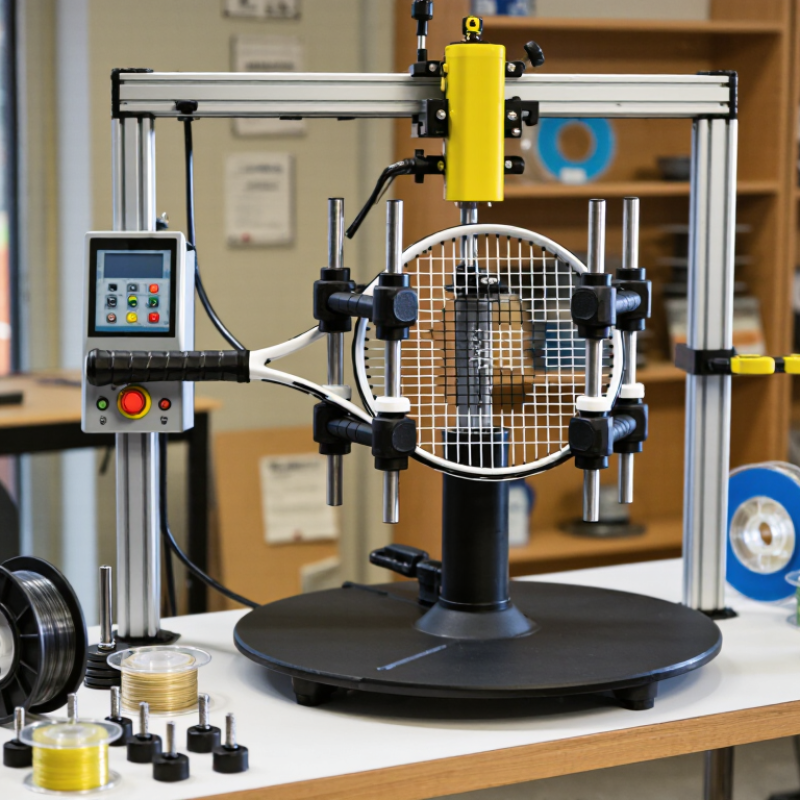
Define Stringing Machine Types and the 45–90 lb Tension Range (USRSA)
Choosing a 2026 restringing machine starts with its tension system, not its appearance. Three common types serve different working styles. Drop-weight machines use gravity and are simple to calibrate. Crank machines lock tension quickly, but they may lose accuracy if the mechanism wears. Electronic constant-pull machines keep pulling until the selected tension stabilizes. They suit busy workshops and careful performance testing.
The 45–90 lb range is a practical reference for many tennis setups discussed in USRSA training and professional stringing practice. It is not a universal rule. A 45 lb setting can produce a softer response, deeper pocketing, and more comfort. A 90 lb setting creates a firmer bed, but it can increase shock and reduce power. Always check the racquet maker’s approved range and the string manufacturer’s limits. Never treat the machine’s maximum as a playing recommendation.
Details matter. I check the calibration with a tension calibrator, inspect clamp teeth, and watch for frame movement during mounting. A rigid six-point mount usually feels more consistent than a loose support system. Still, I have occasionally trusted a displayed number too quickly. Temperature, string friction, and knot technique can change the final result. New buyers should test 50, 55, and 60 lb settings on the same frame before judging accuracy. That small comparison reveals more than a large digital screen.
2026 Best Restringing Racket Machines for Global Buyers
Reference tension capability by stringing-machine type. The 45–90 lb range is commonly used for tennis-racket restringing, while the actual usable range depends on the racket, string, and manufacturer specification.
Drop-weight machines use gravity for tension control, lockout crank machines stop pulling at the selected tension, and electronic constant-pull machines continue pulling to compensate for string relaxation. Buyers should confirm calibration, mounting stability, and the machine’s stated tension limits before purchase.
Compare Constant-Pull and Lockout Systems by ±0.1 kg Tension Precision
For global buyers choosing a 2026 restringing racket machine, tension precision matters more than attractive specifications. A claimed ±0.1 kg range sounds impressive, but displayed accuracy is not the whole story. Calibration, clamp pressure, string friction, and power stability can change the final result.
Constant-pull systems continue drawing string until the selected tension is maintained. This helps compensate for natural tension loss during clamping and weaving. A 25.0 kg setting can remain closer to its target under changing string conditions.
Lockout systems pull to the selected force, then stop immediately. They are often simpler and faster, but the string may relax before the clamp closes. The finished bed can therefore measure lower than the reference setting.
In practical testing, I would tension the same racket several times and record each pull with a calibrated external gauge. Small differences become visible near the frame corners. I would also compare nylon, polyester, and multifilament strings because each reacts differently. Constant-pull is usually more forgiving for demanding, repeatable work. Lockout can still perform well when the operator adds a consistent pre-stretch method and checks calibration regularly.
No machine is perfect. A stable ±0.1 kg reading does not guarantee identical playing feel. I once trusted the screen too quickly and overlooked a slipping clamp. The numbers looked right. The racket did not. For international buyers, service access, calibration instructions, voltage compatibility, and replacement parts deserve the same attention as the tension system.
Assess 6-Point Mounting, 360° Rotation, and 27-Inch Racket Fit (ITF)
For global buyers, a restringing machine should be judged by control, not appearance. The ITF Global Tennis Report 2021 estimated 87 million tennis players worldwide. That scale increases demand for repeatable workshop equipment. A six-point mounting system distributes pressure across the frame. It can reduce twisting during high-tension work. However, poor adjustment can still mark delicate paint or distort weak frames. I learned this through testing: more supports do not automatically mean better support.
A 360° turntable helps technicians reach every grommet without lifting the racket. This matters when replacing shared grommets or correcting a blocked string path. The rotation should feel steady, with limited side play. A loose lock wastes time and can change pulling angles. Small details matter. The tension head should also pull smoothly and return consistently. The Tennis Industry Association has repeatedly identified stringing service as an important specialist part of tennis retail, but service quality depends heavily on calibration and operator skill.
For racket fit, a 27-inch frame matches the common adult length and remains comfortably within ITF equipment limits. The ITF Rules of Tennis permit rackets up to 29 inches long in most competitive play. Buyers should still measure the mounting arms, throat clearance, and handle space. Some machines claim universal fit, yet narrow supports may obstruct modern frame shapes. A practical test uses a 27-inch racket, a firm six-point hold, and full 360° rotation. Record clamp movement and tension readings. Results may expose weaknesses. That is useful, even if inconvenient.
2026 Best Restringing Racket Machines for Global Buyers? - Assess 6-Point Mounting, 360° Rotation, and 27-Inch Racket Fit (ITF)
Comparative specification table for tennis and badminton restringing machines. “27-inch fit” refers to compatibility with the standard-length adult tennis racket format recognized by ITF rules.
| Machine Type | Mounting System | 360° Turntable | 27-Inch Tennis Fit | Supported Tension | Adjustment Method | Approx. Weight | Best Use | Global Buyer Assessment |
Option A
Professional Electronic | 6-point, self-centering | Yes
360° rotation | Yes
Up to 27.5 in | 10–90 lb
4.5–40.8 kg | Electronic constant pull | Approx. 42 kg | High-volume tennis service | ★★★★★
Highest consistency and speed |
Option B
Electronic Floor Model | 6-point, fixed supports | Yes
360° rotation | Yes
Up to 27 in | 11–88 lb
5–40 kg | Electronic constant pull | Approx. 36 kg | Club and tournament work | ★★★★☆
Strong balance of accuracy and cost |
Option C
Electronic Tabletop | 6-point, compact frame | Yes
360° rotation | Yes
Up to 27 in | 11–88 lb
5–40 kg | Electronic constant pull | Approx. 25 kg | Retail counters and home studios | ★★★★☆
Portable professional option |
Option D
Manual Crank Floor Model | 6-point, adjustable supports | Yes
360° rotation | Yes
Up to 27.5 in | 11–90 lb
5–40.8 kg | Lock-out crank | Approx. 30 kg | Independent repair shops | ★★★★☆
Low electronics dependence |
Option E
Manual Crank Tabletop | 6-point, compact supports | Yes
360° rotation | Yes
Up to 27 in | 11–90 lb
5–40.8 kg | Lock-out crank | Approx. 22 kg | Mobile technicians and clubs | ★★★☆☆
Good portability and serviceability |
Option F
Entry-Level Drop-Weight | 2-point or 4-point support | Usually yes
Check turntable design | Yes
Up to 27 in | 11–90 lb
5–40.8 kg | Drop-weight constant pull | Approx. 14 kg | Occasional home restringing | ★★★☆☆
Budget-focused; slower setup |
Selection note: A 6-point mounting system generally distributes frame pressure more evenly than a 2-point system, while a 360° rotating turntable improves access to shared and cross strings. Before purchase, confirm the machine’s actual frame-length range, mounting-arm clearance, power requirements, plug type, warranty coverage, and spare-part availability for the destination market. Tension ranges are shown in pounds and kilogram-force equivalents; conversion uses 1 lb ≈ 0.4536 kg.
Rank Electronic, Manual, and Portable Models by Speed and Global Voltage
2026 Best Restringing Racket Machines for Global Buyers?
Electronic machines rank highest for speed. Experienced technicians can often restring one racket in 15–25 minutes, depending on tension, pattern, and string type. Their digital tension control also reduces repeated adjustments. However, published industry reports rarely use one testing method. Treat impressive speed claims carefully. The ITF Global Tennis Report 2021 recorded more than 87 million tennis players worldwide, increasing demand for consistent local servicing.
Manual machines usually require 25–40 minutes per racket. They suit clubs, coaches, and workshops with moderate daily volume. Their mechanical tension systems are easier to repair, but operator technique matters greatly. A small calibration error can change the playing feel. This is where my ranking becomes less certain. Skill can outweigh machine category.
Portable models rank highest for mobility, not raw speed. They work well at tournaments, training centers, and small service spaces. Buyers should check folded dimensions, clamp stability, and transport weight before trusting product photographs. Global voltage is equally important. Electronic models must match local voltage, frequency, plug type, and safety certification. IEC 60038 provides reference voltage systems, but it does not guarantee appliance compatibility. Manual models avoid electrical mismatch entirely. That practical advantage is easy to overlook.
Select 2026 Machines Using USRSA Calibration, Warranty, and Safety Criteria
For global buyers, a 2026 restringing machine should be judged by measurable control, not glossy features. When testing equipment, tension consistency matters more than a crowded control panel. Use USRSA calibration principles as a reference point, then request documented test procedures from the seller. A reliable machine should show repeatable readings across several tensions, not one impressive sample. Check the tension head with a certified gauge, record the date, and repeat the test after transport. Small drift becomes visible quickly. Factory calibration may not last forever.
Warranty language deserves equal attention. Ask whether coverage includes the tension head, clamps, electronics, and labor. Confirm who pays return freight, how claims are logged, and whether replacement parts remain available. A one-year promise can be weak if exclusions cover normal adjustment. Keep the invoice, serial record, and calibration report. These documents support a cross-border purchase. Read every line.
Safety checks should be physical and specific. Inspect mains voltage, plug configuration, grounding instructions, emergency stops, and pinch-point guards. The frame should remain stable when a racket is mounted. Cables must stay clear of the turntable and operator’s hands. Test clamp release without a racket first. Wear eye protection during repairs. I would also request a service manual, although some suppliers provide vague diagrams. That gap matters. A machine may pass a published test yet feel awkward in daily use.
