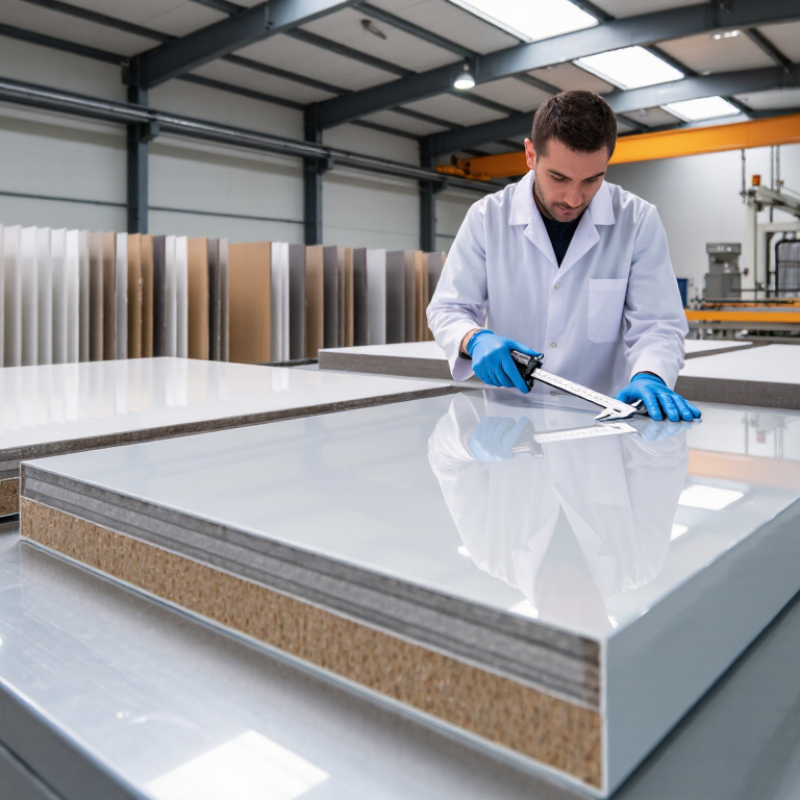
China has become a major sourcing destination for Composite Wall Panels, offering broad material choices, scalable production, and competitive project pricing. Yet global buyers should look beyond attractive quotations. A reliable supplier must explain the panel structure, core density, surface finish, fire performance, thermal values, and installation method. These details affect real buildings, from humid coastal warehouses to cold-climate offices.
Dr. Joseph Lstiburek, a widely cited building-science expert, often reminds practitioners, “Buildings are systems.” That principle matters when evaluating Composite Wall Panels. A strong face sheet cannot correct poor joints, weak insulation, or careless detailing. Buyers should request factory test reports, batch information, technical drawings, and evidence of quality-control procedures. Samples should be checked by hand. Look for flat edges, consistent coating, secure bonding, and clean protective film.
Small details matter.
Experienced Chinese manufacturers may provide custom thicknesses, colors, fire-rated options, and cut-to-size production. However, customization can increase lead time and complicate replacement orders. This is where some purchasing plans become unrealistic. A panel may perform well in a laboratory but fail when installers ignore drainage, fastener spacing, or movement gaps. Local building codes also differ, so independent review remains important.
This guide examines how global buyers can compare Chinese Composite Wall Panels with greater confidence. It considers materials, manufacturing capability, documentation, testing, logistics, and after-sales support. The goal is not to promote the cheapest product. It is to identify a dependable wall system for the building, climate, budget, and long-term maintenance plan. Mistakes still happen. Careful verification reduces their cost.
China Best Composite Wall Panels for Global Buyers
Composite wall panels combine a facing material with an insulated core. Common facings include steel, aluminum, or fiber cement. Cores may use mineral wool, polyurethane, or expanded polystyrene. This layered structure provides strength, thermal resistance, and faster installation than many traditional wall systems. Factory-controlled production can also reduce site waste and uneven workmanship. My field experience suggests that panel performance depends heavily on joint sealing, not only core thickness.
Global buyers are paying closer attention to energy performance. The 2023 UNEP Global Status Report for Buildings and Construction states that buildings and construction produced 37% of global energy-related and process CO2 emissions in 2022. The International Energy Agency also identifies building envelopes as important for reducing heating and cooling demand. Composite panels support this goal, but claims require caution. Actual results vary with climate, orientation, fasteners, and installation quality. A high R-value cannot repair an open seam.
Tips: Check declared thermal values, fire-test standards, moisture resistance, and panel tolerances. Request independent test reports and production samples. Confirm compliance with local building codes before ordering. Compare delivered cost, not factory price alone. Transport damage, customs procedures, and replacement panels can change the calculation. This part is often underestimated. Buyers should also inspect core density and coating thickness, because small differences may affect durability, safety, and long-term maintenance.
Composite wall panels combine a protective skin with a lightweight core. The core material largely determines thermal, acoustic, fire, and moisture performance. Mineral wool offers strong fire resistance and useful sound absorption. PIR and phenolic foam provide higher insulation values with thinner panel sections. EPS costs less, but it may need careful fire and temperature evaluation. Aluminum honeycomb cores reduce weight and improve stiffness, although they usually provide limited thermal insulation.
The outer skins also matter. Coated steel resists daily impacts and supports fast installation. Aluminum reduces corrosion concerns in humid environments. Cement-based or magnesium-based boards can provide a solid, textured surface for demanding interiors. Adhesive quality, joint design, and edge sealing affect performance as much as the core itself. A well-insulated panel can still fail when rainwater enters an unsealed joint.
For global buyers, technical documents should show density, thermal conductivity, fire test results, water absorption, and dimensional stability. Ask for samples with real joint details, not only flat panel pieces. Check whether the panel remains stable after temperature cycling. Small defects often appear around cut edges first. No core wins every project. A thinner panel may save space, yet a denser core can improve impact resistance and acoustic comfort. I would also review installation training and replacement procedures before placing a large order. That step is sometimes overlooked.
China’s composite wall panels vary widely, even when their surfaces look nearly identical. Global buyers should compare the core, thickness, weight, and intended installation method. Aluminum composite panels are lightweight and easy to fabricate. Fiber cement panels offer stronger mass and a more mineral appearance. HPL panels can provide durable decorative surfaces, but their edge protection needs careful attention.
Ask for measurable specifications, not attractive descriptions. Check panel thickness, density, flatness tolerance, impact resistance, water absorption, and thermal movement. Fire performance must be supported by current laboratory reports for the complete wall system, including joints and insulation. A panel can pass alone and perform differently after installation. That detail is often missed. Request production samples, batch records, and installation guidance before placing a large order. Compare fixing systems too, because hidden clips and exposed screws affect labor, maintenance, and final alignment.
Surface finish deserves a hands-on review. Matte textures can hide small scratches better than high-gloss coatings. Woodgrain printing may look convincing from two meters away, yet color repetition can appear obvious across a large façade. Compare samples under daylight, shade, and warehouse lighting. For exterior use, confirm coating type, UV resistance, color tolerance, and cleaning requirements. I would also inspect a cut edge and a drilled hole. Small defects become visible there. One practical weakness is relying on brochures alone; they rarely show how panels age near salt air, heavy rain, or frequent handling.
China Best Composite Wall Panels for Global Buyers
A Step-by-Step Guide to Selecting a Reliable Panel Supplier
Choosing composite wall panels requires more than comparing online prices. Start by defining the project conditions: indoor or outdoor use, humidity, wind exposure, fire requirements, panel thickness, and surface finish. A reliable supplier should explain how each specification affects performance. Request technical data sheets, test reports, and material composition details. Check whether reports come from qualified, independent laboratories.
Ask for physical samples before placing a large order. Inspect the panel edge, coating, core, flatness, and color consistency under natural light. Test the sample against your installation method. A catalog image cannot show bonding strength or handling damage. One practical lesson is easy to miss: the cheapest panel may create higher costs through cutting waste, replacement, or delayed installation.
Tips: Visit the production site, or arrange a live video inspection. Confirm production capacity, quality-control procedures, packaging, lead time, and export experience. Read the warranty carefully, including exclusions and response times. Ask for references from buyers with similar climates and building uses. Keep every approved sample and specification inside the purchase contract. My checklist is not perfect, and suppliers can still make mistakes; clear records make those mistakes easier to identify and correct.
| Selection Step | Key Evaluation Dimension | Practical Benchmark or Required Data | Why It Matters | Documents or Tests to Request | Buyer Decision |
|---|---|---|---|---|---|
| 1. Define the application | Building use and environmental exposure | Record whether the panels are intended for external walls, internal partitions, cold rooms, industrial buildings, warehouses, or modular construction. Note exposure to rain, humidity, salt spray, chemicals, and freeze–thaw cycles. | The required core, facing material, joint design, corrosion resistance, and moisture protection vary substantially by application. | Project specification, climate data, exposure classification, installation drawings, and local building-code requirements. | Create a written performance brief |
| 2. Select the core material | Insulation type and thermal performance | Compare mineral wool, EPS, XPS, PUR/PIR, and honeycomb or non-insulated constructions using declared thermal conductivity. Common product ranges are approximately 0.020–0.045 W/m·K, depending on core material, density, temperature, and ageing. | Lower thermal conductivity can reduce the panel thickness needed to achieve a target U-value, but it must be assessed together with fire, moisture, and ageing performance. | Thermal-conductivity report based on ASTM C177, ASTM C518, EN 12667, or an equivalent recognized method. | Compare declared values at the same test conditions |
| 3. Confirm thermal design | Whole-wall U-value and thermal bridging | Calculate the complete assembly U-value in W/m²·K, including panel joints, fasteners, framing, corners, openings, and thermal bridges. Do not select panels by core conductivity alone. | Heat loss is controlled by the complete wall system rather than the insulation core in isolation. | U-value calculation following ISO 6946 or the applicable national method; thermal-bridge details; condensation-risk assessment. | Approve the assembly, not only the panel |
| 4. Check fire safety | Reaction to fire and fire resistance | Separate reaction-to-fire classification from fire-resistance rating. A panel should be evaluated for the required class or rating for the project, such as EN 13501-1 classification or an applicable ASTM/NFPA-based system. | Fire behavior depends on the core, facings, adhesives, joints, fasteners, and complete wall construction. | Full-scale or applicable fire-test reports, classification reports, fire-resistance reports, and tested assembly drawings. | Reject unsupported fire claims |
| 5. Verify mechanical strength | Wind load, impact, bending, and fastener capacity | Request design values for panel span, allowable wind pressure, concentrated load, deflection, impact resistance, and screw pull-out. Values must be stated for the proposed thickness, span, support spacing, and temperature range. | Nominal thickness does not by itself demonstrate structural or cladding performance. | Product test reports, load tables, calculation notes, panel-span charts, and fastener test data. | Match data to the actual support layout |
| 6. Evaluate moisture durability | Water absorption, vapor control, and joint sealing | Review water absorption, vapor permeability, capillary behavior, drainage, and the durability of sealants and joint profiles. For humid or coastal projects, specify compatible corrosion-resistant accessories. | Moisture can reduce insulation performance, promote corrosion, and damage facings or adhesives. | Water-absorption test, vapor-permeability data, weathering results, joint details, sealant technical data, and maintenance instructions. | Require a complete moisture-management detail |
| 7. Inspect facing materials | Surface coating, corrosion resistance, and appearance | Confirm facing-metal type and thickness, coating system, color tolerance, gloss, scratch resistance, and suitability for the local environment. Metallic coatings are commonly specified by coating mass or thickness and must be confirmed in the technical datasheet. | Facing durability affects appearance, corrosion protection, cleanability, and service life. | Coating certificate, thickness records, salt-spray or cyclic-corrosion test where relevant, color and gloss specifications, and sample approval. | Approve a production sample before mass manufacture |
| 8. Confirm dimensional quality | Panel thickness, length, width, squareness, flatness, and joint tolerance | Use project-specific tolerances and verify them with an inspection plan. Check tongue-and-groove or joint geometry, effective cover width, edge alignment, and cut-edge treatment. | Dimensional variation can cause leakage, visible misalignment, installation delays, and increased waste. | Approved drawings, dimensional inspection records, calibration certificates, first-article inspection, and pre-shipment photographs. | Set measurable acceptance tolerances |
| 9. Audit supplier capability | Quality-management and production controls | Assess documented incoming-material inspection, batch traceability, process control, calibration, nonconforming-product handling, and corrective-action procedures. ISO 9001 certification can support the review but does not replace product testing. | Consistent production controls reduce variation between samples and delivered batches. | Quality manual, process flow chart, inspection and test plan, calibration records, batch traceability sample, and corrective-action records. | Audit the process and records |
| 10. Validate documentation | Test-report authenticity and scope | Ensure reports identify the tested product, thickness, core density, facings, joint configuration, test date, laboratory, standard, and result. The tested construction must match the proposed project assembly. | A report for a different thickness, core, coating, or joint cannot automatically be applied to the purchased product. | Complete laboratory report, classification document, product datasheet, material certificates, and signed technical declarations. | Check traceability from report to shipment |
| 11. Review logistics | Packaging, container loading, storage, and transport risk | Confirm panel dimensions, package quantity, gross weight, loading method, moisture protection, edge protection, lifting instructions, and maximum storage period. Calculate usable container volume before placing the order. | Incorrect packaging or unsupported stacking can cause dents, distortion, water damage, and avoidable freight costs. | Packing specification, loading plan, package photographs, bill of materials, shipping marks, and storage instructions. | Approve the packing method before shipment |
| 12. Compare total cost | Landed cost and lifecycle value | Compare panel price, accessories, freight, duties, installation labor, cutting waste, maintenance, replacement risk, and expected service conditions. Use the same thickness, performance level, delivery terms, and quantity for every quotation. | The lowest purchase price may not provide the lowest installed or lifecycle cost. | Itemized quotation, harmonized product description, packing list, freight estimate, duty information, warranty terms, and installation-cost assumptions. | Select on verified landed cost |
| 13. Conduct pre-shipment inspection | Batch conformity and visual quality | Inspect random packages for dimensions, surface defects, color consistency, joint fit, edge damage, labels, quantities, and accessories. Confirm the batch number against production and test records. | Pre-shipment inspection identifies problems before international transport and site installation. | Approved inspection checklist, sampling plan, inspection photographs, measurement records, and signed release report. | Release only conforming batches |
| 14. Finalize contract controls | Warranty, remedies, change control, and after-sales support | Define the approved specification, permitted substitutions, inspection rights, replacement obligations, delivery schedule, packaging requirements, warranty exclusions, and response times for technical issues. | Clear contract controls reduce disputes when materials, dimensions, colors, or delivery conditions change. | Signed technical specification, approved drawings, quality plan, warranty document, change-order procedure, and installation manual. | Make the approved specification contractual |

International purchasing starts with a clear technical file, not a colorful product photograph. Request panel thickness, core density, surface finish, tolerances, and intended application. Ask for recent test reports covering fire performance, moisture resistance, thermal behavior, and formaldehyde emissions. Requirements differ by destination. A report accepted in one market may not satisfy another authority.
Check factory experience with export packaging and quality control. I would request production samples before approving a full order. Compare color, flatness, edge bonding, and protective film adhesion under ordinary warehouse light. Confirm the inspection method in writing. Include acceptable tolerance limits. Small omissions can create expensive disputes later. Payment terms, inspection points, shipping documents, and Incoterms should match the purchase contract.
Shipping checks deserve practical attention. Panels need dry containers, reinforced corners, moisture barriers, and visible package labels. Review loading photos before departure. Measure the packed volume against the freight quotation. The difference can be surprisingly large. Installation teams need cutting instructions, approved adhesives, joint details, and substrate requirements. Provide these documents in the local working language when possible. On site, check wall flatness and ambient humidity before installation. I have seen good panels fail because installers rushed preparation. That mistake deserves more scrutiny, including from the buyer. Keep spare panels from the same batch for future repairs.
| Cookie | Duration | Description |
|---|---|---|
| cookielawinfo-checkbox-analytics | 11 months | This cookie is set by GDPR Cookie Consent plugin. The cookie is used to store the user consent for the cookies in the category "Analytics". |
| cookielawinfo-checkbox-functional | 11 months | The cookie is set by GDPR cookie consent to record the user consent for the cookies in the category "Functional". |
| cookielawinfo-checkbox-necessary | 11 months | This cookie is set by GDPR Cookie Consent plugin. The cookies is used to store the user consent for the cookies in the category "Necessary". |
| cookielawinfo-checkbox-others | 11 months | This cookie is set by GDPR Cookie Consent plugin. The cookie is used to store the user consent for the cookies in the category "Other. |
| cookielawinfo-checkbox-performance | 11 months | This cookie is set by GDPR Cookie Consent plugin. The cookie is used to store the user consent for the cookies in the category "Performance". |
| viewed_cookie_policy | 11 months | The cookie is set by the GDPR Cookie Consent plugin and is used to store whether or not user has consented to the use of cookies. It does not store any personal data. |