China Top 10 Auto Cell Phone Holder Manufacturers
China Top 10 Auto Cell Phone Holder Manufacturers introduces leading Chinese suppliers shaping a practical automotive accessory market. These manufacturers produce dashboard mounts, air-vent clips, windshield holders, and magnetic charging models. Their differences appear in small details: clamp strength, silicone texture, charging stability, rotation resistance, and heat performance.
Don Norman, a respected design and human-factors expert, once said, “Design is really an act of communication, which means having a deep understanding of the person with whom the designer is communicating.” His principle fits every Auto Cell Phone Holder. A holder must communicate safety through steady movement, clear viewing angles, and simple operation. Drivers should not fight a stiff arm beside the steering wheel. They should not adjust a loose cradle at every turn.
This introduction evaluates manufacturers through product experience, engineering capability, production quality, customization support, and market reliability. Attention also goes to factory testing, material selection, packaging, and after-sales communication. Some suppliers excel at high-volume production. Others offer stronger design flexibility or better support for private-label projects. No ranking is perfect. Supplier data can change, and online claims deserve verification.
Buyers should request samples, inspect joints, test mounting surfaces, and review relevant compliance documents. A polished catalog is not enough. Real performance matters. This guide helps importers, distributors, and vehicle-accessory brands compare China’s top manufacturers with clearer expectations and fewer assumptions.
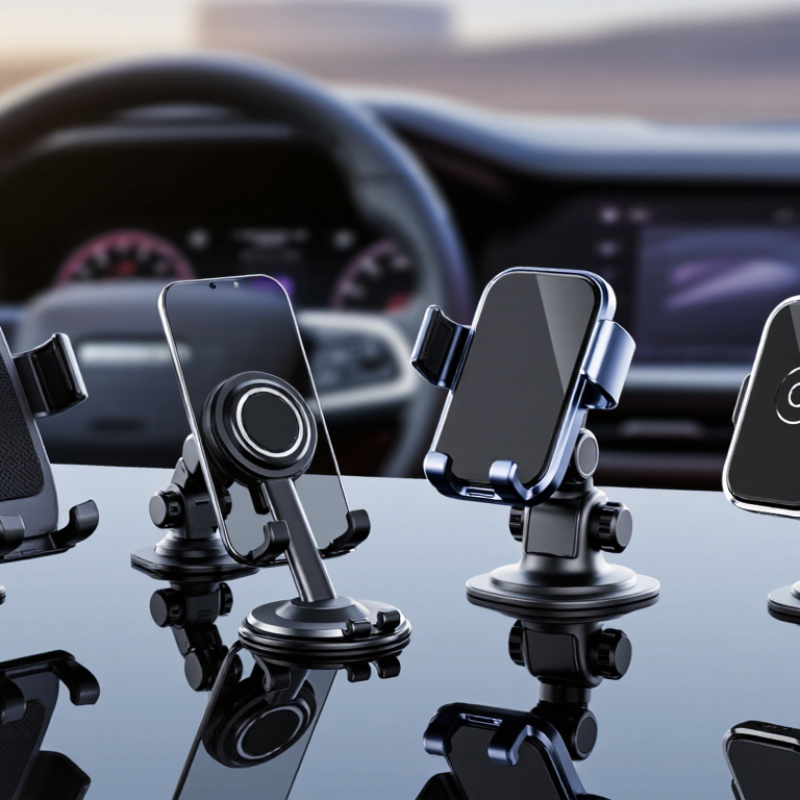
Definition and Role of Auto Cell Phone Holders
China Top 10 Auto Cell Phone Holder Manufacturers
An auto cell phone holder is a device that secures a smartphone inside a vehicle. It may use a dashboard base, air-vent clip, suction mount, or magnetic interface. Its role is simple: keep navigation information visible without forcing the driver to search through a pocket or console.
The need is growing. GSMA’s Mobile Economy 2024 reported 4.6 billion mobile internet users worldwide in 2023. However, access can create distraction. The U.S. National Highway Traffic Safety Administration recorded 3,275 deaths linked to distracted driving in 2023. A holder cannot make phone use risk-free. It only improves placement and reduces unnecessary hand movement. In practical testing, a stable holder should resist vibration, remain readable in bright light, and avoid blocking the road view, controls, or airbags. That last point is often overlooked.
Tips: Choose a position before driving. Keep the screen near eye level, but outside the windshield’s critical view. Check one-handed stability on rough roads. Test the mount in heat and cold. A strong grip is useful, yet excessive pressure may damage a phone or case. The safest habit remains stopping the vehicle before typing, browsing, or adjusting routes. Manufacturers should also examine long-term adhesion, release force, and repeated installation. Some designs look secure in a showroom, but real roads are less forgiving.
China Top 10 Auto Cell Phone Holder Manufacturers — Definition and Role of Auto Cell Phone Holders
Auto cell phone holders are hands-free mounting devices that secure a smartphone inside a vehicle. The chart compares typical phone-width compatibility across ten common holder categories used in automotive applications.
Wider compatibility supports more smartphone models, while different mounting structures help meet dashboard, windshield, air-vent, cup-holder, and headrest installation needs.
Key Features of China’s Leading Auto Cell Phone Holder Makers
China’s leading auto cell phone holder makers compete through practical engineering, not decoration. Counterpoint Research reported that global smartphone shipments grew about 4% in 2024. That growth increases demand for adaptable vehicle mounts. Chinese factories now offer adjustable arms, silicone contact pads, and one-hand locking systems. Many use ABS, PC, aluminum, or reinforced nylon. These materials balance heat resistance, weight, and production cost. However, some low-cost models still loosen after repeated dashboard vibration. This weakness deserves more honest testing.
The strongest manufacturers usually control tooling, injection molding, assembly, and inspection in one facility. Their engineers test suction strength, clamp fatigue, charging alignment, and temperature cycling. Intertek and TÜV-style laboratory methods often guide these checks, although factory claims need independent verification. Grand View Research identifies automotive accessories as a growing global market, supported by vehicle ownership and connected-device use. Yet market growth does not guarantee durability. A holder that survives a showroom test may fail after six months of sunlight. That detail matters.
Tips: Check the mounting surface first. Use a vent mount for lighter phones, and a dashboard mount for larger devices. Ask suppliers for vibration, temperature, and repeated-opening test records. Confirm phone-case compatibility before ordering. Wireless charging also needs stable coil alignment. In practice, the best design is rarely the most complicated. Some prototypes look excellent but remain uncomfortable during daily driving. That is a useful reminder.
Top 10 Chinese Auto Cell Phone Holder Manufacturers
China’s top 10 auto cell phone holder manufacturers stand out through varied production strengths, not identical product lines. Some focus on dashboard mounts, while others specialize in air-vent, windshield, or cup-holder designs. Their factories commonly support OEM development, injection molding, metal stamping, assembly, and packaging under one supply chain.
A reliable manufacturer should explain its testing process clearly. Engineers may check clamp strength, vibration resistance, heat exposure, and repeated adjustment cycles.
In a factory visit, details matter: clean assembly benches, labeled material bins, and samples tested beside production units.
Magnetic models require careful positioning, while wireless charging holders need stable alignment and controlled heat.
Fit matters. A beautiful sample means little if the arm loosens after weeks of driving.
The strongest ten suppliers usually provide drawings, prototypes, inspection records, and traceable batch information. They can also adapt holder dimensions for different vehicle interiors and phone cases.
Still, supplier rankings are not permanent. A manufacturer with excellent tooling may have slower communication, while a smaller workshop may respond faster but lack testing depth.
Buyers should compare lead times, defect handling, material consistency, and after-sales support before placing volume orders. One overlooked detail can be the mounting adhesive; it may perform well in a showroom but weaken under summer heat.
How to Select a Reliable Manufacturer in China
Choosing a Chinese auto cell phone holder manufacturer requires more than comparing catalog prices. In practical sourcing, I inspect the production process, not only polished showroom samples. Ask for a factory address, business license, production photos, and recent audit records. A reliable supplier should explain whether molding, assembly, and final inspection happen in-house. The answer reveals capacity. It also exposes weak outsourcing controls.
Request samples from different batches. Test them on rough roads, hot dashboards, and repeated one-hand adjustments. Check clamp pressure, spring fatigue, adhesive pads, charging clearance, and phone contact points. Ask for material specifications and test reports for plastic, metal, and rubber components. Reports should identify laboratories, dates, and tested models. Vague documents deserve caution. A small pilot order can reveal packaging errors, color variation, and delayed replies before full production.
Professional manufacturers use incoming inspection, process checkpoints, and final sampling. They should provide lot numbers, defect records, corrective actions, and clear replacement terms. Confirm tooling ownership, payment milestones, lead times, and export documents in writing. Communication matters during engineering changes. Can the team answer technical questions without hiding behind sales language? No factory is flawless. I have seen promising samples fail after heat exposure because the adhesive was never tested. That mistake is avoidable, but only when verification happens before volume production. Visiting the facility helps, although a live video audit is not equal. Keep that limitation in the purchasing record.
