
Choosing a Marine Trolling Motor Battery is about more than picking the largest number on a label. Your motor’s current draw, fishing time, boat weight, and charging routine all matter. A battery that looks adequate at the dock may disappoint after hours of slow maneuvering against wind or current. That is when careful sizing becomes real.
Marine electrical educator Nigel Calder, author of Boatowner’s Mechanical and Electrical Manual, emphasizes matching battery capacity to the equipment’s actual load. Put simply: plan around the motor’s draw and the time you expect to run it. Treat that as a sizing principle, not a verbatim quotation. Check your motor manual for maximum current, then compare battery capacity and usable energy with your expected hours on the water. Battery chemistry also affects weight, charging needs, and performance. Follow the battery and charger manufacturers’ specifications.
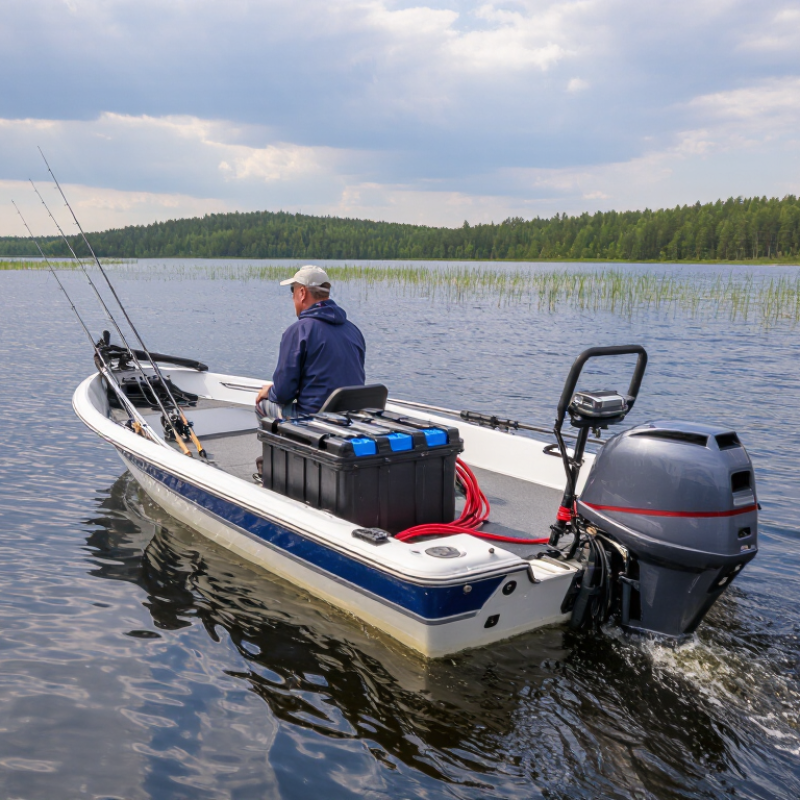
Picture a small boat moving across a breezy lake, with the trolling motor holding position near a weed line. Repeated bursts of power can change the day’s energy use. A calm-water estimate may not tell the whole story. Leave a practical reserve, and keep charging conditions in mind. Exact run time varies.
This guide will explain capacity, voltage, battery types, charging compatibility, and installation considerations. It will also help you compare specifications without assuming that the highest amp-hour rating is always the best choice. A real-world detail matters: a heavy battery can affect handling, while an undersized one can shorten a fishing trip. The right match depends on your boat, motor, and routine. Check the numbers twice. We’ll also flag where estimates can fall short, because battery planning is not perfectly predictable.
Assess your trolling motor’s voltage before comparing batteries. A 12-volt motor needs a 12-volt battery system; 24- and 36-volt motors require correctly matched series-connected batteries or equivalent packs. Check the motor’s manual and nameplate, not just the battery tray. ABYC Standard E-11 provides marine electrical-system guidance, while the Battery Council International Battery Technical Manual explains why rated capacity depends on discharge conditions. Small print matters.
Then match capacity to measured current draw and the hours you expect to fish. For a simple estimate, a 12-volt motor drawing 50 amps uses about 600 watts; a 100-amp-hour battery would supply that load for roughly two hours in ideal conditions. Real runtime may be shorter because speed, propeller load, temperature, battery age, and voltage limits affect usable energy. Treat the calculation as a planning estimate, not a promise. Check whether the battery’s continuous-discharge rating meets the motor’s maximum current, and leave reserve for wind or a long return. A clamp meter can reveal your typical draw on the water. I once trusted the capacity label alone; that was optimistic. Use the motor maker’s current specifications alongside BCI discharge guidance, then size for your actual fishing day.
| Assessment | What to Check | How to Use the Information |
|---|---|---|
| Motor system voltage | Check the motor’s manual or rating label for its required nominal voltage: commonly 12 V, 24 V, or 36 V. | Match the battery system to the motor. For batteries connected in series, their voltages add; the amp-hour capacity remains that of one battery in the series string. |
| Maximum current draw | Find the motor’s maximum current draw, usually listed in amperes (A), in the manufacturer’s specifications. | Use this to check battery and wiring current capability. Maximum draw is not necessarily the current used throughout a trip. |
| Expected average current | Estimate the current used at your usual speed and conditions, or measure it during typical operation. | Use average current—not maximum current alone—to estimate runtime. Wind, current, boat load, speed, and repeated acceleration can change consumption. |
| Target operating time | Decide how many hours of trolling time you need before recharging. | Estimate usable capacity with: average current (A) × operating time (hours) = required usable amp-hours (Ah). |
| Battery chemistry and usable capacity | Compare the battery’s rated capacity with the portion recommended for regular use. Usable capacity depends on chemistry, battery design, temperature, age, and discharge rate. | For preliminary sizing, a conservative planning allowance is about 50% of rated capacity for many lead-acid deep-cycle batteries and about 80% for many lithium iron phosphate (LiFePO₄) batteries. Follow the battery maker’s limits. |
| Charging and installation | Check charger compatibility, battery arrangement, terminal protection, cable sizing, and the motor’s installation instructions. | Use a charger designed for the battery chemistry and voltage. Follow marine electrical safety guidance and the instructions for the motor and batteries. |
Capacity-sizing examples (illustrative): The current values below are assumed average operating currents, not specifications for a particular motor. Estimated rated capacity uses planning allowances of 50% usable capacity for lead-acid and 80% for LiFePO₄.
| Motor System | Assumed Average Current | Target Runtime | Required Usable Capacity | Approx. Rated Capacity: Lead-Acid | Approx. Rated Capacity: LiFePO₄ |
|---|---|---|---|---|---|
| 12 V | 30 A | 4 hours | 120 Ah | 240 Ah | 150 Ah |
| 24 V | 40 A | 3 hours | 120 Ah | 240 Ah | 150 Ah |
| 36 V | 50 A | 2.5 hours | 125 Ah | 250 Ah | about 157 Ah |
Example calculation: 30 A × 4 hours = 120 Ah of usable capacity. At a 50% planning allowance, 120 Ah ÷ 0.50 = 240 Ah of rated lead-acid capacity; at an 80% allowance, 120 Ah ÷ 0.80 = 150 Ah of rated LiFePO₄ capacity. These estimates are starting points; verify actual capacity, discharge limits, and system requirements in the relevant product manuals.
Estimate trolling-motor runtime from current draw, not thrust rating alone. A motor may draw 20 amps at mid-range, but wind, weeds, boat load, and frequent turns can raise demand. Check the motor’s current chart at your battery voltage. Peak draw alone does not predict a full trip.
For a quick estimate, divide usable battery amp-hours by average amps. A 100-Ah battery with 80 Ah available, paired with a 20-amp draw, gives about four hours. That matters. Treat this as a planning estimate, not a promise: speed, water conditions, and temperature all affect runtime.
Choose capacity by multiplying expected average draw by hours on the water, then add a reserve. If you expect 18 amps for five hours, plan for about 90 usable Ah, plus extra capacity. The battery’s rated capacity may need to be higher. Lead-acid and lithium batteries have different usable-capacity limits, so follow the maker’s discharge guidance and confirm voltage compatibility. Keep a margin. Early estimates can look too tidy; a headwind may extend a trip. Track actual use over several outings and adjust your estimate.
For a marine trolling motor, battery chemistry affects weight, runtime, maintenance, and charging needs. Flooded lead-acid batteries are often less expensive, but they need regular electrolyte checks and secure, ventilated installation. Spilled water in a battery compartment is a warning sign, not a minor inconvenience. AGM batteries are sealed and need less routine attention, though they remain heavy and can be damaged by repeated deep discharge. Weight matters.
Lithium iron phosphate batteries usually offer lower weight and more usable capacity, but the battery management system and charger must suit the motor and battery specifications. Check the motor’s voltage requirements, continuous current draw, and any low-temperature charging limits before choosing. Cold mornings matter. A battery’s advertised capacity does not guarantee the same runtime under every load; wind, weeds, boat weight, and speed all change consumption. Not always obvious. Compare usable energy, warranty terms, and charging compatibility rather than price alone. One detail is easy to miss: a lighter battery may improve handling, but it does not automatically make an undersized setup reliable. Verify the manufacturer’s instructions, and leave a practical reserve for the return trip.
Choosing a trolling motor battery starts with matching its voltage to the motor’s requirement. Check the manual and battery label rather than relying on appearance. Capacity, measured in amp-hours, affects how long the motor can run. Estimate typical current draw and hours on the water, then allow extra capacity for wind, current, and repeated speed changes. That estimate can still be optimistic.
Check the battery compartment’s length, width, and height before buying. Leave room for cables and secure mounting; a battery that barely fits can shift in choppy water. Weight matters, too. A heavier battery may affect trim or make removal awkward, especially in a small boat. Measure twice. Also confirm the battery type is suitable for marine use and compatible with the motor’s specified voltage and connection.
Charging needs are easy to overlook. Use a charger with a profile designed for the battery chemistry, and verify its output matches the battery maker’s guidance. Some battery types need different charging settings, so one charger should not be assumed suitable for every setup. Consider how quickly you need to recharge between trips and whether the charger can be stored safely aboard. Keep terminals protected from moisture, and check connections for looseness or corrosion during routine maintenance. A tidy installation helps, but it is not a substitute for checking the specifications.
A trolling motor battery should be secured against shifting when the boat pitches or crosses wakes. Check that its voltage and capacity match the motor and charger specifications. A loose connection can heat up, while saltwater spray can corrode exposed terminals. Keep metal tools away from the battery posts. For flooded lead-acid models, follow the manual’s ventilation and water-level instructions; sealed batteries still need protection from water intrusion. Small details matter. Never charge a battery that is visibly damaged.
Read the warranty before buying, not after a problem appears. Check its term, required proof of purchase, and exclusions for improper charging, physical damage, or neglected maintenance. Some warranties require specific installation or service records. Keep the receipt, model details, and dated photos together. A long warranty sounds reassuring, but the claim process and coverage limits matter too.
Plan for routine care across the boating season. Inspect cables for cracked insulation and terminals for corrosion. Recharge promptly after use, and store the battery according to its chemistry and the manufacturer’s temperature guidance. A simple log of charging dates can reveal changing performance. It is easy to overlook slow capacity loss until a long run home. Test the battery periodically under load, or ask a qualified marine technician to check it.
| Cookie | Duration | Description |
|---|---|---|
| cookielawinfo-checkbox-analytics | 11 months | This cookie is set by GDPR Cookie Consent plugin. The cookie is used to store the user consent for the cookies in the category "Analytics". |
| cookielawinfo-checkbox-functional | 11 months | The cookie is set by GDPR cookie consent to record the user consent for the cookies in the category "Functional". |
| cookielawinfo-checkbox-necessary | 11 months | This cookie is set by GDPR Cookie Consent plugin. The cookies is used to store the user consent for the cookies in the category "Necessary". |
| cookielawinfo-checkbox-others | 11 months | This cookie is set by GDPR Cookie Consent plugin. The cookie is used to store the user consent for the cookies in the category "Other. |
| cookielawinfo-checkbox-performance | 11 months | This cookie is set by GDPR Cookie Consent plugin. The cookie is used to store the user consent for the cookies in the category "Performance". |
| viewed_cookie_policy | 11 months | The cookie is set by the GDPR Cookie Consent plugin and is used to store whether or not user has consented to the use of cookies. It does not store any personal data. |