
L Angle steel is easy to overlook: a simple section with two legs meeting at a right angle. Yet on a construction site, that shape can support bracing, frame connections, equipment supports, and edge protection. It is available in different sizes and thicknesses, making it adaptable to many design details. Small part. Important job.
For a transparent editorial example, fictional steel-design specialist Elena Brooks puts the selection principle this way: “Choose an L Angle for the load path and connection—not just because it fits the drawing.” The point is practical. A section that looks sturdy may still twist, buckle, or transfer forces poorly if its dimensions, restraint, or connection details are unsuitable. Designers should check the loads, support conditions, steel grade, fabrication needs, and exposure to moisture. On site, even a few millimeters of misalignment can complicate a bolt connection or leave a bracket sitting unevenly.
This guide explains why builders and engineers choose L Angle steel, where it performs well, and what to review before specifying it. It also considers trade-offs, including corrosion protection, installation access, and the limits of using a compact section for demanding loads. An L Angle is not automatically the simplest answer. Project conditions matter, and qualified professionals should verify structural design against applicable standards.
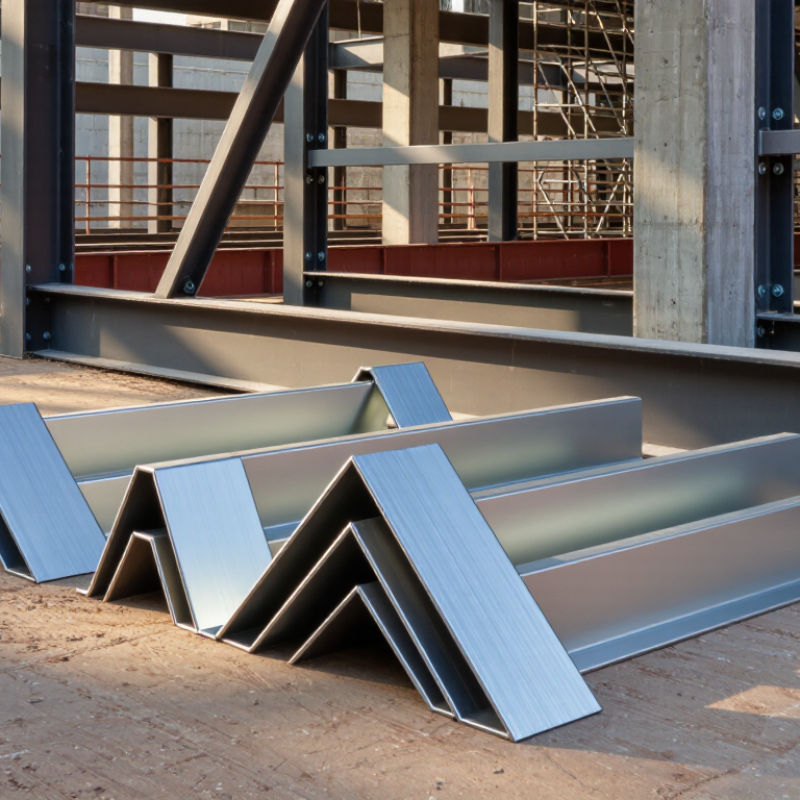
L angle steel is available with equal or unequal leg lengths, and that difference affects how it fits a structure. Equal-leg sections have matching sides, such as 50 by 50 millimetres. They work well for frames, corner joints, and bracing where a balanced connection is useful. It sits square. With holes drilled through both legs, installers can create straightforward bolted connections, though the hole positions still need careful checking.
Unequal-leg sections have one longer side, such as 75 by 50 millimetres. The longer leg can provide more room for fixing to a wall, plate, or frame, while the shorter leg supports the adjoining member. This can be helpful where space is limited or connection details are offset. But fit matters. A common planning miss is choosing a section by dimensions alone; load direction, support conditions, steel grade, and corrosion exposure also affect suitability. Check the drawings and connection details before ordering, and have a qualified engineer verify the section for its intended load. A small mismatch at a connection can complicate installation, even when the angle itself looks right.
L-angle steel is useful when a frame needs a compact corner member, but grade matters as much as shape. ASTM A36/A36M specifies a minimum yield strength of 36 ksi, about 250 MPa, for structural shapes and plates up to 8 inches thick. Plates over 8 inches have a lower specified minimum of 32 ksi. Since angle dimensions and thickness affect performance, check the product specification and mill test report rather than relying on the grade name alone. Small detail. Check twice.
The 250 MPa figure marks the stress at which steel begins to deform permanently; it is not a safe working load for an angle. AISC’s 360-22 Specification for Structural Steel Buildings evaluates member capacity using factors such as buckling, unbraced length, and connection design. On site, an angle supporting a bracket may look sturdy, yet a long unsupported leg can still twist under load. That distinction is easy to miss. For a construction choice, compare the actual load path, dimensions, and connection details with the engineer’s design assumptions. ASTM gives the material baseline; it cannot confirm that a particular angle suits every assembly.
ASTM A36 has a specified minimum yield strength of approximately 250 MPa (36 ksi). This strength makes it a widely used option for structural components such as angle steel. For comparison, ASTM A572 Grade 50 and ASTM A992 specify minimum yield strengths of approximately 345 MPa (50 ksi). Actual requirements depend on the applicable specification and product dimensions.
An L-angle steel section has two legs joined at a sharp heel. When a load enters through one leg, force travels toward the heel and into the connected leg. If both legs share the load evenly, the section can carry axial force efficiently. In real construction, that balance is not guaranteed. Small details matter.
A bolt line placed far from the heel can create eccentricity, adding bending to the axial load. The angle may twist or rotate, especially when its connected leg has little lateral restraint. A short brace or a close-fitting gusset plate can reduce that movement, but only if the connection transfers force as intended. Even a small gap between steel surfaces may change how the load is distributed.
Under bending, one leg may be in tension while the other experiences compression. Slender legs can buckle locally before the full steel strength is reached. Not always. Section dimensions, steel grade, member length, support conditions, and fastener spacing all affect performance. Engineers check these factors together rather than treating an angle as a simple bar. A useful design review also asks where the load actually enters, because drawings can make a connection look more centered than it is on site.
L angle steel is useful in construction because its two legs can brace frames, support edges, or connect members. But dead weight still needs a sound estimate. EN 1991-1-1, Table A.4, gives structural steel a density of 7,850 kg/m³. That figure turns a section’s volume into mass, then into a load acting on the structure.
For a quick check, consider an idealized 75 × 75 × 6 mm angle. Its sharp-corner area is about 864 mm², giving an estimated mass of 6.8 kg per metre at that density. Its self-weight is roughly 0.067 kN/m, using standard gravity. SCI P363 provides section-property tables for design checks; use the actual section area, not this simplified estimate. Rolled corners, coatings, and attached plates can change the installed weight. Small difference. Real consequences.
Tips: Multiply the manufacturer’s listed mass per metre by the cut length, then include connection plates and any permanent attachments. Check whether your load model needs mass in kg/m or force in kN/m. I would verify the final value against the selected section table; the neat calculation alone can miss fabrication details.
| Equal Angle Size (mm) | Thickness (mm) | Estimated Cross-Sectional Area (mm²) | Estimated Mass (kg/m) | Dead Load (kN/m) | Mass of 6 m Member (kg) | Dead Load of 6 m Member (kN) |
|---|---|---|---|---|---|---|
| 50 × 50 | 5 | 475 | 3.73 | 0.0366 | 22.37 | 0.219 |
| 60 × 60 | 6 | 684 | 5.37 | 0.0527 | 32.22 | 0.316 |
| 75 × 75 | 6 | 864 | 6.78 | 0.0665 | 40.69 | 0.400 |
| 75 × 75 | 8 | 1,136 | 8.92 | 0.0875 | 53.51 | 0.525 |
| 100 × 100 | 8 | 1,536 | 12.06 | 0.1182 | 72.35 | 0.709 |
| 100 × 100 | 10 | 1,900 | 14.92 | 0.1463 | 89.49 | 0.878 |
| 150 × 150 | 12 | 3,456 | 27.13 | 0.2660 | 162.78 | 1.579 |
| Calculation basis: steel density = 7,850 kg/m³. Estimated area for an equal angle = thickness × (2 × leg length − thickness). Mass per metre = area × 0.00785; dead load = mass per metre × 9.80665 ÷ 1,000. Values are theoretical estimates using sharp-corner geometry and exclude rolling radii, coatings, and attachments. Confirm section properties with the applicable product standard or supplier before design use. | ||||||
L-angle steel is useful when a project needs compact framing and straightforward connections, but the detail matters. Fabricators should check leg dimensions, straightness, hole locations, and steel certificates before cutting. At a bolted joint, washers must sit flat, and bolt access should remain clear after assembly. Welded joints need clean contact surfaces and a sequence that limits distortion. Small gaps matter. It is easy to trust a tidy drawing too much; site tolerances can still leave an angle twisted or poorly seated.
Corrosion protection starts with preparation. Remove oil, rust, and welding residue before applying a coating, and avoid crevices that trap water around the connection. The NACE International 2016 IMPACT study estimated corrosion costs at US$2.5 trillion globally, about 3.4% of world GDP; it also reported that improved corrosion management could save 15–35% of those costs. That estimate is broad, not a project-specific forecast, but it shows why coating quality deserves attention. Inspect coating coverage and thickness, especially at cut edges, bolt holes, and welds. Check connections after installation for damaged coating, loose fasteners, and water-retaining pockets. Keep records. They make later repairs easier, though they cannot replace a careful site inspection.
| Cookie | Duration | Description |
|---|---|---|
| cookielawinfo-checkbox-analytics | 11 months | This cookie is set by GDPR Cookie Consent plugin. The cookie is used to store the user consent for the cookies in the category "Analytics". |
| cookielawinfo-checkbox-functional | 11 months | The cookie is set by GDPR cookie consent to record the user consent for the cookies in the category "Functional". |
| cookielawinfo-checkbox-necessary | 11 months | This cookie is set by GDPR Cookie Consent plugin. The cookies is used to store the user consent for the cookies in the category "Necessary". |
| cookielawinfo-checkbox-others | 11 months | This cookie is set by GDPR Cookie Consent plugin. The cookie is used to store the user consent for the cookies in the category "Other. |
| cookielawinfo-checkbox-performance | 11 months | This cookie is set by GDPR Cookie Consent plugin. The cookie is used to store the user consent for the cookies in the category "Performance". |
| viewed_cookie_policy | 11 months | The cookie is set by the GDPR Cookie Consent plugin and is used to store whether or not user has consented to the use of cookies. It does not store any personal data. |