How to Choose a Range Exhaust Hood?
A Range Exhaust Hood does more than remove cooking odors. It captures smoke, grease, heat, and moisture before they spread through the kitchen. Choosing one, however, is not just a matter of picking a style. The right model depends on your cooktop’s width, cooking habits, kitchen layout, and available ventilation route.
Start by checking the hood’s capture area and airflow rating against your range and the manufacturer’s guidance. A narrow hood can let rising steam escape around its edges. A powerful unit may still disappoint if its duct is poorly sized or sharply bent. Ducted models send air outdoors, while ductless models filter and return it to the room. Each option has trade-offs. Noise matters, too. A loud fan can make an otherwise capable hood unpleasant to use during dinner.
Look closely at installation requirements, filter access, lighting, and control placement. Imagine wiping grease from a filter after a week of frying, or trying to reach a switch above a hot pan. Small details become daily ones. Product specifications are useful, but they cannot fully predict performance in every kitchen. Even a well-chosen hood cannot correct every ventilation problem. That is worth admitting. This guide will explain the key features to compare, the measurements to take, and the questions to ask before buying. With careful checks, you can choose a Range Exhaust Hood that fits your cooking space and is practical to maintain—not merely attractive in a showroom.
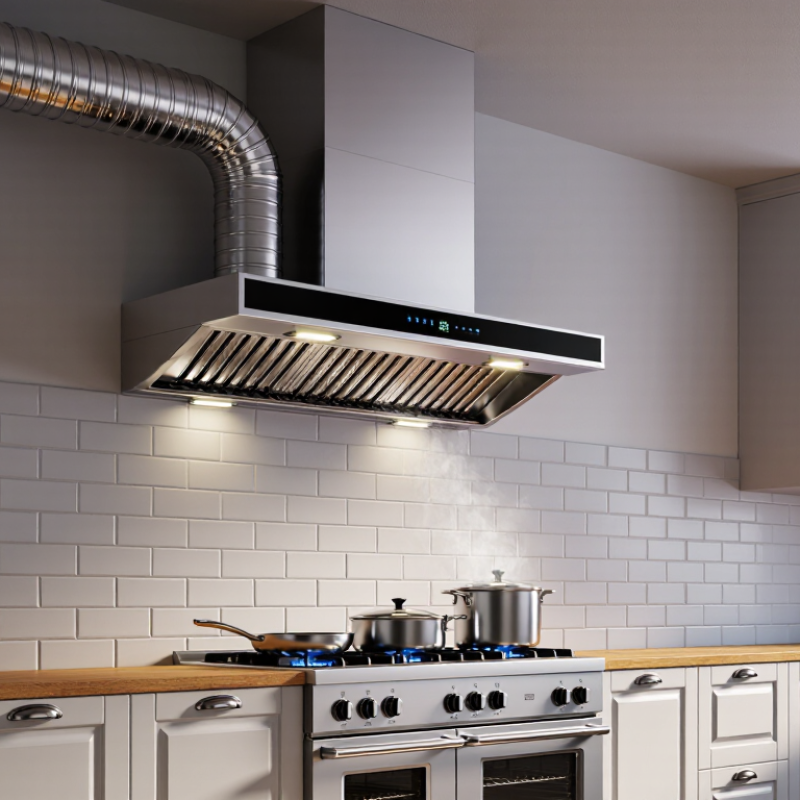
Assess Your Cooking Habits and Kitchen Layout
How to Choose a Range Exhaust Hood?
Assess Your Cooking Habits and Kitchen Layout
Start with what happens at your stove on an ordinary evening. Boiling pasta produces less grease than searing fish or frying dumplings. If you cook with oil often, look for a hood designed to capture smoke and grease across your usual cooking area. A quiet fan may encourage you to use it every day. That matters. Check the stated noise level at the fan speed you are likely to use, not only its lowest setting.
Measure the cooktop and note where the hood can sit. A hood should generally cover the cooking surface, but the correct width and mounting height depend on the appliance and installation instructions. Cabinets, a low ceiling, or a nearby window can affect placement. So can ductwork. A short, direct duct route is often easier to plan than one with several bends. If exterior venting is impractical, compare recirculating models and their filter replacement needs.
Think about the whole room, too. An open kitchen may let cooking odors drift toward a sofa, while a compact kitchen can feel noisy quickly. I would not choose fan power from one number alone; room size, cooking style, hood shape, and duct resistance all matter. Check the range and hood specifications, and ask a qualified installer about a difficult duct route. Small details change the fit.
How to Choose a Range Exhaust Hood
Assess Your Cooking Habits and Kitchen Layout
Estimated airflow needs by cooktop width and hood layout
These planning estimates use a common rule of thumb: about 100 CFM per foot of cooktop width for a wall-mounted hood and 150 CFM per foot for an island hood. They are not code requirements. Frequent high-heat cooking or frying may call for greater capture capacity; check the hood manufacturer’s guidance and local requirements, and make sure your kitchen can accommodate the required ducting.
Compare Range Hood Types and Venting Options
A range hood should match the cooktop’s location and the path air can take out of the kitchen. Wall-mounted models suit ranges against a wall, while island hoods need coverage from above and often feel more exposed to room drafts. Under-cabinet models save space, but check that their capture area covers the burners. Inserts can fit custom cabinetry. Measure the cooking surface before choosing; a hood that looks generous in a showroom may feel narrow over a wide range.
Venting choice affects performance. Ducted hoods carry smoke and moisture outdoors, usually through a wall or roof. A short, smooth duct run with few bends generally moves air more effectively than a long, winding one. I would check the route twice. A tidy cabinet plan can conceal an awkward elbow. Recirculating models filter air and return it indoors, which can help where outdoor venting is impractical. They do not remove cooking moisture, though, and their filters need regular replacement or cleaning.
Match airflow and noise to how you cook, not just to a large number on a specification sheet. Frequent searing produces more smoke than occasional simmering. That matters. Also check the installation instructions for duct size, clearances, and electrical needs; these vary by model. A quieter hood may be used more often, but “quiet” depends on the speed setting. I’d compare sound ratings at the settings you expect to use, then confirm the duct plan with a qualified installer.
Choose the Right Hood Size and Airflow Capacity
When choosing a range hood, start with the cooking surface, not the room’s appearance. The hood should generally be at least as wide as the cooktop; a wider canopy can catch more smoke from large pans. Measure the cooking surface and the available wall or cabinet space. A narrow hood may miss steam drifting from a skillet’s outer edge. Check the installation height against the hood maker’s instructions, since placement affects both capture and safe clearance.
Airflow capacity is usually listed in cubic feet per minute, or CFM. Higher numbers are not automatically better. Frequent high-heat searing or wok cooking may need more airflow than light simmering, while long ducts and multiple bends can reduce performance. A common sizing estimate for gas ranges uses about 100 CFM per 10,000 BTU of burner output, but it is only a starting point. Duct layout and local ventilation requirements matter too. Check the range specifications and ask a qualified installer to assess the duct route. Measure twice. I’ve found that estimating duct bends from memory is easy—and often wrong.
Evaluate Noise Levels, Filters, and Controls
A range hood should capture cooking fumes without drowning out conversation. Compare noise ratings at the speeds you will actually use, not only the quietest setting. A hood may sound gentle on low but become distracting when searing or boiling. If possible, listen to it running in a showroom, and check how the rating was measured. Room size and duct layout can also affect perceived noise, so published numbers are useful, but not the whole story.
Tips: Stand near the hood and test each control. Imagine using it while a pan is sizzling.
Filter choice affects both maintenance and performance. Metal mesh filters are commonly washable; baffle filters are sturdier and often suited to frequent, heavier cooking. Follow the manufacturer’s cleaning instructions, since grease buildup can reduce airflow and add odor. Charcoal filters are used in many recirculating setups, but they need periodic replacement. It is easy to forget that cost.
Controls should be reachable and clear, especially when your hands are damp or occupied. Buttons, sliders, and touch panels each have trade-offs; touch controls can be harder to use with greasy fingers. Look for distinct fan-speed settings and a light control you can find quickly. There is no perfect layout. Choose one that feels intuitive in your kitchen, not merely attractive in a product photo.
Confirm Installation Requirements and Maintenance Needs
Before comparing airflow ratings, confirm that the hood fits your kitchen and can be installed as specified. Measure the cooking surface, cabinet opening, and available space above the range. Check the installation manual for required clearances, duct diameter, and electrical access. Details vary by model. Measure twice; it saves trouble.
Trace the duct route from the hood to the exterior wall or roof. Long runs, tight bends, and undersized ducts can reduce performance and increase noise. I still double-check this part, especially in older kitchens where hidden framing can change the plan. Ask a qualified installer to assess structural or electrical changes, and check whether local requirements call for additional ventilation.
Maintenance matters just as much as installation. Look for removable filters that you can reach without stretching over hot burners. Metal filters usually need regular washing; follow the care instructions and let them dry fully before reinstalling. Wipe the hood’s underside with a suitable cleaner, since cooking grease can collect around seams and controls. Check how filters are removed before buying. It sounds minor, but awkward access can make routine cleaning easy to postpone.
