
A loud room does not always need thicker walls. Sometimes, it needs less echo. Hard surfaces—glass, painted drywall, and polished floors—reflect speech and footsteps, making conversations feel sharper and more tiring. An Indoor Acoustic Wall Panel can absorb some of those reflections. It cannot, by itself, soundproof a room or stop every neighbor’s noise.
The World Health Organization’s Guidelines for Community Noise recommends keeping indoor bedroom sound below 30 dB LAeq at night for good-quality sleep. That is a health guideline, not a promise that any panel will deliver a particular result. Panel performance depends on material, thickness, coverage, placement, and the room itself. The Noise Reduction Coefficient (NRC), commonly measured under ASTM C423, describes sound absorption in a laboratory; it is not a measure of sound blocking.
Details matter. A fabric-wrapped panel above a desk may soften a bright, fluttering echo, while a thin decorative panel may do little in a large, bare room. Architectural acoustics professor Lily M. Wang’s work offers a useful distinction: treating room reflections is not the same as isolating sound between rooms. That difference is easy to overlook. This guide compares seven indoor panel options, focusing on absorption ratings, construction, installation, and practical fit. Use the ratings as a starting point, not a guarantee. Real rooms can behave differently.
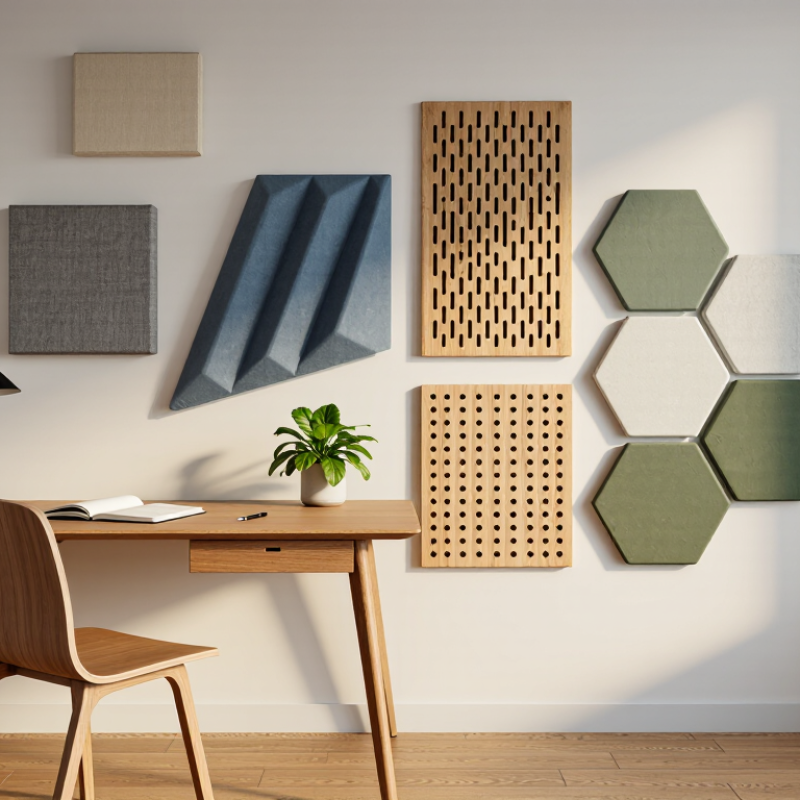
Indoor acoustic wall panels reduce noise by absorbing part of the sound that would otherwise bounce around a room. Their porous cores let sound waves enter, where friction converts some of their energy into small amounts of heat. Less reflected sound means less echo and a clearer feel to speech. The change is easiest to notice in a bare room with hard floors, glass, and painted walls.
Placement matters. Panels near a desk, meeting table, or frequently used seating area can soften reflections reaching listeners. A few panels spaced across a wall often work better than one small patch. Thickness and an air gap behind a panel can improve absorption at lower speech frequencies, though results depend on the room and materials. Small details count.
These panels do not block noise from a neighboring room or stop traffic sounds from entering through a window. That distinction is easy to miss. They improve the room’s acoustics; soundproofing usually requires addressing gaps, doors, walls, or windows. If a room still feels harsh after installation, the panels may be too thin, poorly placed, or simply too few. It is worth checking the echo before adding more.
| Panel Type | Typical Construction | How It Reduces Noise | Indicative NRC Range* | Best Indoor Uses | Key Consideration |
|---|---|---|---|---|---|
| Fabric-Wrapped Fiberglass | Porous fiberglass core covered with acoustically transparent fabric; commonly available in 1–2 in. thicknesses. | Porous fibers dissipate sound energy as sound waves pass into the panel, reducing reflections and reverberation. | About 0.70–1.00 | Offices, meeting rooms, classrooms, studios, and living rooms. | Performance depends on thickness, mounting method, and whether an air gap is used. |
| Mineral Wool Panels | Dense, fibrous mineral-wool core, often finished with fabric or a protective facing. | Absorbs a broad range of reflected sound; thicker panels and spaced mounting can improve lower-frequency absorption. | About 0.70–1.00 | Home theaters, music rooms, offices, and other spaces with noticeable echo. | Check the product’s facing, edge finish, and installation requirements. |
| PET Felt Panels | Rigid or semi-rigid panels made from compressed polyester fibers, sometimes including recycled content. | Fiber structure absorbs some sound reflections, especially in the mid and high frequencies. | About 0.30–0.85 | Shared workspaces, classrooms, corridors, and decorative wall layouts. | Thin panels may provide limited low-frequency absorption; verify fire and cleaning specifications. |
| Perforated Wood Panels | Wood or wood-based facing with holes or slots over an absorptive backing and cavity. | Sound passes through the openings to the backing material, where it is absorbed; the panel can also provide a hard-wearing finish. | About 0.40–0.90 | Conference rooms, libraries, auditoriums, and interiors needing a wood finish. | Absorption depends on perforation pattern, backing, cavity depth, and panel installation. |
| Wood Slat Panels with Acoustic Backing | Spaced wood slats mounted over a porous acoustic layer, commonly felt or mineral fiber. | Gaps between slats allow sound to reach the absorptive backing, reducing reflected sound while retaining a slatted appearance. | About 0.30–0.85 | Living areas, offices, reception spaces, and feature walls. | Slats alone are mostly reflective; the backing and open-area ratio drive absorption. |
| Open-Cell Acoustic Foam | Lightweight open-cell foam, typically installed as shaped or flat wall tiles. | Air movement through the cells creates friction that absorbs some sound energy, primarily at mid and high frequencies. | About 0.30–0.80 | Small recording spaces, practice rooms, and targeted reflection-control areas. | It does not soundproof a room; confirm fire safety and suitability for the intended interior. |
| Fabric-Covered Recycled Textile Panels | Panels made from compressed textile fibers or recycled fiber batts, often finished with fabric. | Porous fibers absorb reflected sound and can help reduce room reverberation when coverage is adequate. | About 0.40–0.95 | Offices, schools, home studios, and multipurpose rooms. | Results vary with fiber density, thickness, mounting, and the tested panel configuration. |
How the panels reduce noise: Indoor acoustic wall panels absorb sound reflections inside a room, helping reduce echo and reverberation. They generally do not block sound traveling through walls, doors, or windows. *NRC ranges are indicative, not guaranteed ratings for every product; compare product-specific laboratory test reports. NRC is commonly reported using ASTM C423, and actual performance depends on panel thickness, mounting, air gap, room conditions, and frequency.
Start with the room’s problem, not a panel’s advertised score. A ringing voice in a tiled meeting room needs absorption; traffic passing through a wall needs sound isolation. Different jobs. The Noise Reduction Coefficient (NRC) summarizes absorption at 250, 500, 1,000, and 2,000 Hz under ASTM C423 reverberation-room testing. An NRC of 0.80 does not mean 80% less noise in every room. Check the frequency chart: thin panels may absorb speech well but perform less effectively on low bass. The World Health Organization’s Guidelines for Community Noise recommend bedroom levels near 30 dB LAeq to protect sleep. Treat that as context, not a promise any panel can meet.
Look for test results that specify panel thickness, mounting gap, and tested area; these details affect performance. A 50-millimeter panel with an air gap can behave differently from one fixed flat. Compare the test setup with your own wall, then assess coverage, placement, cleanability, edge durability, and fire-performance documentation. Panels often help most near reflection points, such as the wall beside a desk. NRC alone cannot tell you how much sound crosses between rooms. Before-and-after readings from the same position can offer a rough check, though phone measurements are imperfect. I would question a high rating without frequency data. Convenient numbers can hide gaps.
A useful starting point when comparing panels is understanding how the Noise Reduction Coefficient (NRC) is calculated. The four octave-band absorption coefficients shown below contribute equally to the NRC average.
When evaluating panels, compare tested absorption data across these frequencies, along with panel thickness and installation details. The NRC is the average of the absorption coefficients at 250, 500, 1000, and 2000 Hz, rounded to the nearest 0.05; it does not describe performance at every frequency.
Indoor panels mainly absorb reflections; they rarely block sound passing through a wall. ASTM International’s C423 test method measures sound absorption by frequency. Its Noise Reduction Coefficient, or NRC, averages results at 250, 500, 1,000, and 2,000 Hz, then rounds the value to the nearest 0.05. Higher NRC generally means greater absorption across those frequencies, not equal performance at every pitch. Check the full test report, not just one headline number.
Fabric-wrapped fiberglass and mineral-wool panels are common choices for broad speech and room-echo control. PET felt is lighter and often thinner, but its performance depends on thickness and backing. Acoustic foam can tame reflections near a desk; it does little to stop bass or sound through a door. Perforated wood combines a hard finish with an absorptive backing, while slatted wood can diffuse reflections as well as absorb them. Microperforated panels offer a cleaner surface, though their response depends on precise construction. Seven options. Different trade-offs. In a small room, a few panels placed at ear-height reflection points may help more than covering every wall. That is not always obvious. Measure the room, compare frequency-specific test data, and remember that placement can be imperfect.
Choosing indoor acoustic panels starts with identifying the noise. In a home office, voices and keyboard clicks bounce between hard walls. Fabric-wrapped absorbers on the wall behind a screen can reduce those reflections and make calls clearer. They will not stop a neighbor’s television passing through a thin wall. That needs better sealing, added mass, or construction changes.
For classrooms and meeting rooms, judge the result by reverberation, not panel count. ANSI/ASA S12.60 sets a 0.6-second maximum reverberation time for core learning spaces up to 10,000 cubic feet. This is a useful benchmark, not a promise that every room needs the same treatment. Measure the furnished room first; curtains, carpets, and full bookshelves already absorb some sound. More panels can make speech feel unnaturally dry.
Bedrooms call for a different check. The World Health Organization’s 1999 Guidelines for Community Noise recommend indoor nighttime noise below 30 dB LAeq for good sleep. Wall panels may soften echoes, but they cannot reliably lower outside traffic to that level. For persistent low rumbles, such as buses or building equipment, thin decorative panels are often a poor fix. Look for measured absorption data across frequency bands, and address gaps around doors and windows. Real rooms are imperfect. So is any one-size-fits-all panel plan.
Installation matters as much as panel quality. In a furnished room, clap once and listen for a sharp flutter between parallel walls. Place panels where sound first reflects: often beside the listening position, behind speakers, and on the ceiling above a desk or table. Leave some bare wall; coverage does not need to be uniform. For a practical guide, use a mirror along the side wall: where you can see a speaker from your seat is a useful first-reflection point.
Set realistic goals. Absorptive panels reduce reflections and reverberation inside a room; they do not reliably block voices or traffic coming through a wall. ANSI/ASA S12.60-2010/Part 1 (R2020) sets a 0.6-second reverberation-time limit for certain unoccupied core learning spaces up to 10,000 cubic feet, illustrating why room decay matters. Check panel test data based on ASTM C423, including its Noise Reduction Coefficient (NRC), but remember that NRC does not describe performance at every frequency. My first layout would not be my last; a little listening and adjustment can reveal missed spots.
Tips: Start with two panels at ear height on opposing side walls. Sit in your usual position and listen to speech or a familiar recording. Move one panel at a time. Keep panels clear of heaters, vents, and door swings, and follow the mounting instructions for your wall type.
| Cookie | Duration | Description |
|---|---|---|
| cookielawinfo-checkbox-analytics | 11 months | This cookie is set by GDPR Cookie Consent plugin. The cookie is used to store the user consent for the cookies in the category "Analytics". |
| cookielawinfo-checkbox-functional | 11 months | The cookie is set by GDPR cookie consent to record the user consent for the cookies in the category "Functional". |
| cookielawinfo-checkbox-necessary | 11 months | This cookie is set by GDPR Cookie Consent plugin. The cookies is used to store the user consent for the cookies in the category "Necessary". |
| cookielawinfo-checkbox-others | 11 months | This cookie is set by GDPR Cookie Consent plugin. The cookie is used to store the user consent for the cookies in the category "Other. |
| cookielawinfo-checkbox-performance | 11 months | This cookie is set by GDPR Cookie Consent plugin. The cookie is used to store the user consent for the cookies in the category "Performance". |
| viewed_cookie_policy | 11 months | The cookie is set by the GDPR Cookie Consent plugin and is used to store whether or not user has consented to the use of cookies. It does not store any personal data. |