
China Top 10 Egg Packaging Machine Manufacturers?
Choosing the right Egg Packaging Machine manufacturer requires more than comparing product photos or advertised prices. This guide examines China’s leading suppliers through practical, verifiable criteria. These include manufacturing experience, machine design, food-contact materials, production consistency, and after-sales support. The goal is not to praise every large factory. It is to identify suppliers that may fit different egg-processing operations.
Real performance appears on the factory floor. A reliable machine should handle clean, accurately aligned cartons, stable conveyor movement, and consistent output during extended operation. Buyers should request videos, technical drawings, sample testing, and references from comparable farms or packing centers. Factory audits can reveal details that brochures often miss, such as spare-parts storage, assembly quality, and technician availability. Certifications also require careful checking. A certificate’s scope, issuing body, and validity matter more than a logo on a website.
No ranking is permanently perfect. Supplier capabilities, models, and service teams can change. Some published specifications may also need independent confirmation. For that reason, this overview presents a balanced starting point rather than an absolute verdict. It considers automation levels, packaging formats, customization, installation guidance, maintenance access, and total ownership costs. Small details matter. A sensor that is difficult to clean can slow an entire packing line. A delayed spare part can affect daily deliveries. Readers should compare these manufacturers against their own egg volume, labor conditions, facility layout, and regulatory requirements before making a final decision.
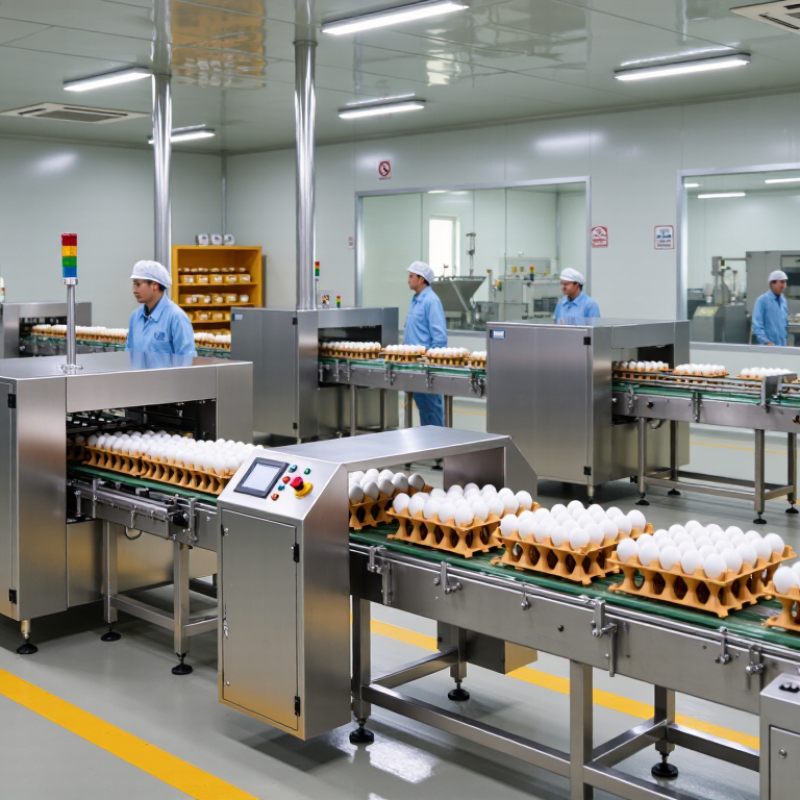
Table of Contents [Hide]
How Egg Packaging Machines Support Modern Poultry Operations
Modern poultry operations depend on reliable Egg Packaging Machines to protect quality from collection to retail. FAO’s World Food and Agriculture Statistical Yearbook 2023 reported more than 86 million tonnes of chicken eggs produced globally in 2021. That volume makes manual handling increasingly difficult. Automated systems can grade eggs, arrange them into trays, and reduce unnecessary contact. Cleaner movement supports better hygiene control.
Packaging equipment also improves labor efficiency and traceability. Sensors can detect cracks, monitor pack counts, and record production batches. The USDA’s Food Safety and Inspection Service emphasizes time, temperature, cleanliness, and traceability as practical food safety controls. A well-designed line supports these controls through consistent handling. It also reduces product damage during repetitive operations. Small details matter. A poorly adjusted conveyor can create hidden losses.
Energy use and maintenance deserve equal attention. The International Energy Agency reports that industrial motor systems account for a significant share of industrial electricity demand, so efficient drives and scheduled maintenance can reduce avoidable consumption. However, automation is not automatically efficient. Dust, shell fragments, and unstable egg sizes can interrupt performance. Operators still need experience, inspection routines, and sensible adjustments. Some machines promise more than farms can realistically use. That deserves honest review. Choosing equipment should involve throughput, cleaning access, spare-part availability, worker training, and local service capability.
China Top 10 Egg Packaging Machine Manufacturers? - How Egg Packaging Machines Support Modern Poultry Operations
Anonymized comparison of representative Chinese manufacturer profiles and commercial egg-packaging machine capabilities
| Rank | Manufacturer Profile | Primary Machine Focus | Typical Throughput | Egg Handling Range | Packaging Formats | Automation Level | Key Poultry-Operation Benefit |
|---|---|---|---|---|---|---|---|
| 1 | Profile A | High-speed grading and packing line | 30,000–60,000 eggs/hour | Small to extra-large chicken eggs | 30-egg trays, 6-egg and 12-egg cartons | Fully automatic | Supports large farms by combining grading, counting, weighing, and carton loading in one continuous line. |
| 2 | Profile B | Medium-capacity carton packing system | 15,000–30,000 eggs/hour | Standard chicken eggs, approximately 40–75 g | 6-egg, 10-egg, and 12-egg cartons | Automatic with operator-assisted replenishment | Provides a practical balance between labor savings, product presentation, and investment cost. |
| 3 | Profile C | Compact farm egg-packing machine | 5,000–15,000 eggs/hour | Table eggs with controlled size and weight ranges | 30-egg trays and retail cartons | Semi-automatic | Fits small and medium poultry operations where floor space and budget are limited. |
| 4 | Profile D | Tray forming and egg transfer equipment | 10,000–36,000 eggs/hour | Chicken eggs requiring gentle transfer | Paper-pulp trays and plastic reusable trays | Automatic transfer | Reduces manual handling and helps lower the risk of shell cracking during tray loading. |
| 5 | Profile E | Egg grading, inspection, and packing line | 18,000–45,000 eggs/hour | Eggs sorted by weight and visible shell quality | Retail cartons, trays, and bulk cases | Fully automatic inspection and grading | Improves batch consistency by separating eggs into weight classes before retail packing. |
| 6 | Profile F | Robotic case-packing solution | 24,000–48,000 eggs/hour | Graded chicken eggs in cartons or trays | Master cases, trays, and transport cartons | Robotic end-of-line automation | Reduces repetitive lifting and improves end-of-line consistency for distribution-focused farms. |
| 7 | Profile G | Integrated washing, drying, and packing line | 12,000–30,000 eggs/hour | Washed table eggs within the line’s approved operating range | Retail cartons and protective trays | Integrated automatic line | Combines cleaning and packing stages to support more controlled hygiene and product flow. |
| 8 | Profile H | Custom modular packing equipment | 8,000–25,000 eggs/hour | Mixed egg sizes with changeover controls | Trays, cartons, and customer-specific packs | Configurable automation | Allows poultry businesses to expand capacity by adding modules such as conveyors, graders, or carton sealers. |
| 9 | Profile I | Export-oriented egg packaging line | 20,000–50,000 eggs/hour | Commercial eggs sorted by weight class | Retail cartons, pallets, and export cases | High automation with digital controls | Supports standardized packing, traceability, and high-volume preparation for domestic and export distribution. |
| 10 | Profile J | Budget-focused automatic egg packer | 6,000–18,000 eggs/hour | Standard chicken eggs for local markets | 30-egg trays and basic retail cartons | Entry-level automatic | Offers a lower-complexity route to reduce manual packing while maintaining a compact production footprint. |
Throughput figures are representative commercial ranges that vary according to egg size, grading accuracy, packaging format, conveyor configuration, and operating conditions. Actual machine performance should be confirmed through technical specifications and production trials.