
Selecting a dependable manufacturer matters when a small clamp must perform under vibration, heat, pressure, or repeated servicing. Hose Clamps may look simple, but material choice, band geometry, screw quality, and edge finishing can affect fit and durability. A poorly matched clamp can loosen, damage a hose, or complicate maintenance. Details matter.
This guide introduces leading manufacturers for global buyers and explains what to compare before requesting a quotation. It considers product range, manufacturing capabilities, quality controls, documentation, and export experience. Buyers should also check whether a supplier can provide consistent dimensions, material specifications, and samples for evaluation. These details are more useful than broad claims about strength or service life.
Applications differ. A clamp used on a vehicle may face different conditions from one used in industrial equipment or plumbing. Confirm the hose diameter range, operating environment, and installation method with the manufacturer. Ask how products are inspected and whether test information is available for the intended use. A catalog alone is not proof of suitability.
The manufacturers featured here serve different needs, from standard products to specialized designs and larger-volume supply. There is no universal best choice. Lead times, communication, customization, and total delivered cost can change the decision. Even a polished supplier profile deserves careful checking. Samples and clear technical questions can reveal gaps early, though they cannot guarantee long-term performance. Use this overview as a starting point, then verify each supplier against your application and purchasing requirements.
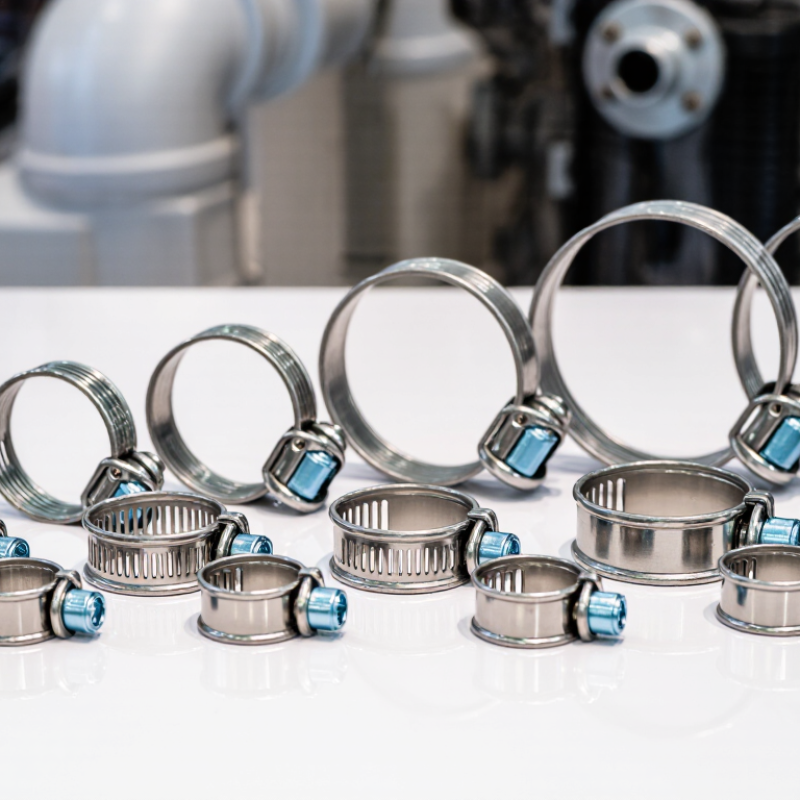
Hose clamps secure flexible tubing to a fitting by applying pressure around the hose. This helps prevent leaks and keeps the hose from slipping while carrying water, air, coolant, or other compatible fluids. Common types include worm-drive, spring, and constant-tension clamps. Each suits different hose materials, temperatures, and vibration levels. They are used in vehicle cooling systems, irrigation lines, appliances, and workshop equipment. A clamp supports a connection; it cannot repair a split hose or compensate for a poorly matched fitting.
Tips: Measure the hose and fitting before choosing a clamp. Check the manufacturer’s guidance for tightening. Too loose can leak; too tight can cut or flatten the hose. Inspect for corrosion, cracks, and movement.
A neat-looking installation is not always a reliable one. Hose material can soften with heat, while vibration may loosen some connections over time. After installation, check that the hose sits evenly on the fitting and that the clamp is positioned behind its raised edge. Recheck the connection after the system has run and cooled. Choosing by eye alone is a weak shortcut, and the right clamp depends on the actual operating conditions.
Worm-drive clamps suit general-purpose connections on coolant, fuel, and low-pressure air hoses. Their slotted bands tighten with a screw, making field adjustments straightforward. Yet the slots can press unevenly into soft hose walls. A smooth inner band is often a better choice for delicate or thin-walled tubing.
Spring-band clamps maintain pressure as hoses expand and contract with temperature. They are common in engine cooling systems, where heat cycling can loosen fixed-torque connections. Tight spaces can make them awkward to install. Small detail. T-bolt clamps provide stronger, more even compression on larger-diameter hoses, such as those used in heavy-duty air ducts and industrial equipment.
SAE International’s J1508 standard sets performance and test requirements for automotive and off-road hose clamps; buyers can use it to compare evidence, not just product descriptions. OICA’s 2023 production statistics report approximately 93.5 million vehicles produced worldwide. That figure shows the scale of automotive applications, but it does not measure clamp demand. For selection, match clamp style to hose material, outside diameter, pressure, vibration, and service temperature. A clamp that seals well on rubber may damage a soft silicone hose. Check the specified tightening torque and inspect the connection after installation. Real systems vary, and catalog guidance alone may not capture every operating condition.
A dependable hose clamp manufacturer should prove more than machining capacity. Ask for drawings, steel-grade certificates, dimensional tolerances, and test records for the exact clamp design. Check band edges, screw engagement, housing alignment, and tightening torque on production samples. Small burrs matter; they can damage a hose during installation. Request corrosion-test results and clarify the test method, duration, and acceptance criteria. A catalogue claim alone is weak evidence.
Use external benchmarks carefully. The ISO Survey 2023 recorded about 1.26 million valid ISO 9001 certificates across 189 countries and economies; certification indicates a quality system, not flawless products. The World Stainless Association’s Stainless Steel in Figures 2024 reported 58.4 million tonnes of stainless-steel melt-shop production in 2023. That scale makes material traceability especially worth checking. Ask how batches are identified from incoming coil to finished clamp, and whether failed lots are documented. Audit the process, not just the certificate. A polished audit can still miss variation between shifts. I would compare samples from separate production runs, then verify lead times, packaging, and change-control procedures before approving a supplier.
Compare material declarations with mill test certificates when assessing a supplier. This chart shows the minimum specified alloy content by mass for 304 and 316 stainless steel under ASTM A240/A240M; a value of 0 means no minimum is specified for that element, not that the element is necessarily absent. Grade alone does not establish a clamp’s corrosion resistance or performance.
Leading Hose Clamp Manufacturers in Global Markets stand out through consistent fit, material control, and dependable production—not simply large catalogs. For global buyers, a clamp must match hose diameter, pressure conditions, temperature, and exposure to moisture or chemicals. Stainless steel can help resist corrosion, while a smooth band edge may reduce hose damage during tightening. Small details matter.
Experienced manufacturers typically provide dimensional specifications, material information, and sample testing for demanding applications. Buyers should compare band width, screw quality, tightening range, and packaging consistency across production batches. Ask how products are inspected, and request documentation that supports the intended use. A polished sample is useful, but it cannot prove every shipment will match. Check the finish. Then verify the fit.
Tips: Share the hose material, working environment, and target diameter before requesting a quotation. Test samples with the actual hose and installation tools. Confirm the required order quantity and lead time in writing. If a clamp loosens during trial installation, review the torque and hose condition before blaming the product; the cause is not always obvious.
| Clamp Type | Typical Construction | Common Applications | Key Buyer Checks | Manufacturing Capability to Assess |
|---|---|---|---|---|
| Worm-drive band clamp | Perforated or non-perforated metal band tightened by a screw mechanism; available in carbon steel and stainless steel. | General-purpose hose connections in automotive, plumbing, irrigation, and industrial equipment. | Confirm hose outside-diameter range, band width, material grade, and whether the band interior is suitable for the hose. | Consistent band forming, screw engagement, dimensional tolerances, and corrosion-resistant finishing. |
| T-bolt clamp | A metal band secured with a T-shaped bolt and nut, often incorporating a bridge or spring element. | Larger-diameter or heavy-duty connections, including some charge-air, coolant, and industrial hose assemblies. | Check clamp range, band width, bolt dimensions, installation clearance, and suitability for the specified joint. | Reliable forming and welding or joining processes, controlled bolt quality, and repeatable assembly performance. |
| Spring-band clamp | Formed spring steel or stainless spring steel designed to apply clamping force through elastic recovery. | Commonly used on selected automotive coolant and heater-hose connections where temperature changes affect hose dimensions. | Verify the specified hose diameter, operating-temperature range, material, and installation method. | Controlled spring properties, forming accuracy, and testing for dimensional stability over repeated cycles. |
| Constant-tension clamp | A clamp design incorporating a spring element to help maintain clamping force as the hose or joint changes dimension. | Applications with thermal cycling or hose-diameter changes, when specified by the equipment or hose-system design. | Confirm the design’s working range and required installation space; performance depends on the complete hose connection. | Spring-force consistency, fatigue testing, and validation on representative hose-and-fitting assemblies. |
| Wire clamp | Formed metal wire tightened by a screw or similar fastening mechanism. | Selected small-hose and light-duty connections where the clamp profile is compatible with the hose and fitting. | Check wire diameter, clamp range, contact profile, and whether the design is appropriate for the hose material. | Accurate wire forming, secure fastening, and inspection for burrs or surface defects. |
| Ear clamp | A formed metal band tightened by compressing one or more raised ears with a suitable installation tool. | Compact hose and tube assemblies, including selected automotive and appliance applications. | Confirm the specified clamp size, installation-tool compatibility, and whether removal or reuse is required. | Consistent ear geometry, material thickness, and validated installation instructions. |
Global sourcing note: Hose-clamp suitability depends on the hose, fitting, fluid, temperature, vibration, and installation method. Do not treat a clamp’s material or type alone as a pressure rating; verify the complete assembly against the application requirements and applicable specifications.
Global buyers should compare hose clamp suppliers using the same drawings, material requirements, and test conditions. Request samples made from the proposed production material, then check band width, edge finish, screw engagement, and fit on the actual hose. SAE J1508 provides performance requirements and test methods for worm-drive clamps. Ask suppliers to identify the test edition and share relevant results, rather than relying on a general claim of compliance.
Quality systems matter, but certification is only one signal. ISO’s 2022 survey recorded more than 1.2 million valid ISO 9001 certificates worldwide. That scale shows how widely the system is used; it does not prove that a particular clamp will resist corrosion or maintain torque. Request material certificates, lot-level inspection records, and corrosion-test results, such as testing performed under ISO 9227. Compare lead times, minimum order quantities, and change-control practices too. A polished report can still miss a weak batch. It happens.
Tips: Ask for a sample from a routine production lot, not a specially prepared sample. Confirm the steel grade, coating thickness, test duration, and acceptance limits in writing. Keep one approved sample as a reference, then compare incoming lots against it.
| Cookie | Duration | Description |
|---|---|---|
| cookielawinfo-checkbox-analytics | 11 months | This cookie is set by GDPR Cookie Consent plugin. The cookie is used to store the user consent for the cookies in the category "Analytics". |
| cookielawinfo-checkbox-functional | 11 months | The cookie is set by GDPR cookie consent to record the user consent for the cookies in the category "Functional". |
| cookielawinfo-checkbox-necessary | 11 months | This cookie is set by GDPR Cookie Consent plugin. The cookies is used to store the user consent for the cookies in the category "Necessary". |
| cookielawinfo-checkbox-others | 11 months | This cookie is set by GDPR Cookie Consent plugin. The cookie is used to store the user consent for the cookies in the category "Other. |
| cookielawinfo-checkbox-performance | 11 months | This cookie is set by GDPR Cookie Consent plugin. The cookie is used to store the user consent for the cookies in the category "Performance". |
| viewed_cookie_policy | 11 months | The cookie is set by the GDPR Cookie Consent plugin and is used to store whether or not user has consented to the use of cookies. It does not store any personal data. |