
Superabrasive

What Are the Top Laser Spare Parts in 2026?

In 2026, a laser system’s performance can depend on parts smaller than a coin. A worn protective window may blur the beam. A clogged nozzle can disrupt cutting. A weak chiller pump may trigger costly downtime. These are the practical reasons buyers ask: What Are the Top Laser Spare Parts in 2026?

The answer varies by process and machine. Common high-priority items include protective windows, focusing lenses, cutting nozzles, ceramic rings, filters, chiller components, and power-supply modules. MarketsandMarkets estimated the broader laser technology market at $20.4 billion in 2023, with growth projected through 2028. That figure covers laser technology, not spare parts specifically. It signals a growing installed base, but does not prove which components sell most. Check each machine’s service history.

Dr. Reinhart Poprawe, former director of Fraunhofer ILT, is a recognized laser-technology expert. A responsible paraphrase of his application-focused engineering perspective is simple: component choices must match the process and operating conditions. This is not a verbatim quotation. In practice, that means checking wavelength, power rating, material compatibility, and manufacturer specifications before stocking parts. Small parts matter. So does evidence: compare replacement intervals, failure records, and supplier documentation. This guide examines the components most worth monitoring, while noting that rankings can shift between fiber, CO₂, and other laser systems.
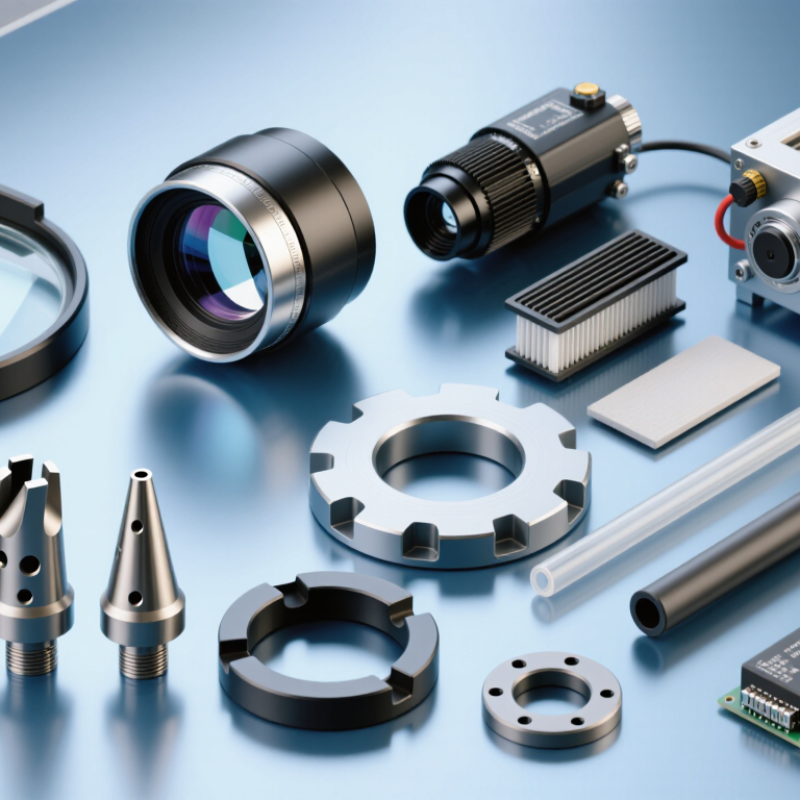
What Are the Top Laser Spare Parts in 2026?

How Laser Spare Parts Are Defined and Classified

What Are the Top Laser Spare Parts in 2026?

How Laser Spare Parts Are Defined and Classified

Laser spare parts are replacement components selected to restore a laser system’s function after wear, failure, or scheduled service. They may sit in the beam path, motion assembly, control cabinet, or cooling circuit. Not all parts affect output equally. Classification helps technicians match components to their role and operating conditions.

Optical parts include lenses, mirrors, protective windows, and beam-delivery components. Their performance depends on factors such as wavelength, coating, dimensions, and damage threshold.

Motion and mechanical parts include rails, bearings, belts, and nozzle assemblies.

Electrical and control parts cover sensors, cables, power modules, and interface boards.

Filters, seals, and other regularly replaced items are often treated as consumables.

The categories are useful, but not perfect. Some components serve several functions, and names can vary between service manuals. For accurate identification, record the machine model, part number, measurements, connector type, and operating specifications.

A technician may also inspect a removed part for heat marks, residue, or uneven wear. Small details matter.

Keep replacement records alongside service dates; otherwise, a correct-looking part may still be an incorrect fit.

Which Laser Source Components Are Most Frequently Replaced?

In 2026, the parts most often replaced around a laser source are usually its protective optical window, cooling filters, and selected electrical or cooling components. Exact replacement frequency depends on operating hours, dust, temperature, and maintenance practices. Small parts matter. A cloudy protective window can reduce beam quality and may show faint discoloration or residue under inspection.

The protective window is commonly treated as a wear item because airborne particles and handling can contaminate it. Replace it when inspection or service guidance indicates damage; avoid touching the optical surface. Cooling filters also need regular attention. A clogged filter can restrict airflow, while a weak fan or failing pump may cause temperature warnings or unstable operation. Check the system’s actual alarms and maintenance records rather than relying on a fixed calendar alone.

Fiber delivery cables and connectors are replaced less predictably, often after physical damage, sharp bending, or connection problems. Pump modules and internal power components can be expensive, but they are not necessarily routine replacements. Their service life varies, and output changes can have several causes. I have seen maintenance plans over-focus on the laser source itself, while ignoring dust around the cabinet. That is an easy assumption to revisit. Keep clear records of output, temperatures, and replaced parts to spot recurring issues early.

What Are the Top Laser Spare Parts in 2026? — Frequently Replaced Laser Source Components
Rank Part System Area Function Typical Replacement Trigger Replacement Pattern
1 Protective window / cover glass Processing head; not usually inside the laser source Protects focusing optics from spatter, dust, and process debris. Contamination, scratches, coating damage, or a visible decline in cut quality. Often the most frequently changed optical consumable in cutting work; inspect regularly and replace when damaged or contaminated.
2 Cutting nozzle Processing head; not a source component Directs assist gas and helps maintain the required standoff and gas flow. Clogging, deformation, impact damage, or inconsistent gas flow. Frequently replaced in production cutting; the interval depends on material, process settings, and collision frequency.
3 Ceramic nozzle holder / ceramic ring Processing head; not a source component Insulates and supports the nozzle assembly and may provide a capacitive height-sensing interface. Cracks, chips, poor electrical contact, or unstable height sensing. Replace on damage or when sensing becomes unreliable; it is not normally a scheduled laser-source replacement.
4 Cooling-system filter Laser source cooling circuit or chiller Captures particles that could restrict coolant flow through the cooling loop. Scheduled maintenance, visible contamination, or a pressure/flow warning. Replace according to the equipment maintenance schedule and coolant condition; a clogged filter can contribute to overheating.
5 Cooling fan Laser source enclosure or chiller Moves air across heat exchangers and electronic components. Bearing noise, reduced airflow, fan alarm, or failure to start. Replaced as needed rather than at a universal interval; heavy dust and high operating temperatures can shorten service life.
6 Pump diode module Inside some fiber-laser sources Provides optical pump energy to the gain fiber. Diagnosed loss of output power, abnormal operating data, or a source fault confirmed by qualified service personnel. Not a routine consumable. Replacement is condition-based and generally requires specialist service.
7 Power supply or driver module Laser source electrical system Supplies and controls power for source electronics and, where applicable, pump modules. Electrical fault, unstable operation, alarm, or component failure found during diagnosis. Replaced when faulty; it is not normally changed on a fixed schedule.
8 Delivery fiber / output connector assembly Laser source output path Delivers laser energy from the source to the processing head. Connector damage, contamination, suspected fiber damage, or a verified transmission problem. Usually not a frequent replacement item. Inspection and correct handling are important because damage can require specialist repair.
Replacement frequency varies with laser type, operating hours, material, environment, maintenance, and process settings. The listed patterns are general maintenance guidance, not guaranteed service intervals. Follow the equipment maker’s instructions, and have internal laser-source components diagnosed and serviced by qualified personnel.

What Optics and Beam-Delivery Parts Lead Demand in 2026?

What Are the Top Laser Spare Parts in 2026?

What Optics and Beam-Delivery Parts Lead Demand in 2026?

In 2026, demand for laser spare parts centers on optics that keep the beam stable and predictable. Protective windows, focusing lenses, mirrors, and collimators are frequent replacements because heat, dust, and process residue can gradually reduce performance. Even a faint haze on a window matters. Operators may notice a rougher cut edge or a changing spot size before a part looks visibly damaged.

Beam-delivery components are also drawing attention. Fiber connectors, delivery cables, nozzle assemblies, and alignment hardware can affect how consistently energy reaches the work surface. A connector that is not seated cleanly may cause unstable output or added heat. Keep suitable replacements on hand, but match specifications carefully: wavelength, power rating, coating, dimensions, and cooling requirements all matter. A lens that fits physically may still be wrong for the system.

Replacement timing is not always obvious. Some shops change optics on a fixed schedule; others inspect them between jobs using approved procedures and compare process results. Neither approach is perfect. Inspection takes time, while calendar-based replacement can discard usable parts. A small log of operating hours, cleaning, and observed defects helps reveal patterns. Check compatibility with the equipment documentation, and avoid touching optical surfaces without the recommended handling method. One fingerprint can become a hot spot.

Which Cooling, Motion, and Control Parts Keep Lasers Running?

What Are the Top Laser Spare Parts in 2026?

Which Cooling, Motion, and Control Parts Keep Lasers Running?

Laser uptime often depends on ordinary components working within narrow limits. Cooling parts deserve close attention: filters, pumps, hoses, flow sensors, and heat exchangers. A clogged filter can reduce coolant flow before an alarm appears. Watch for cloudy coolant, damp fittings, or a pump that sounds rough. Small signs matter.

Motion systems need equally careful checks. Linear guides, bearings, belts, couplings, and servo components affect positioning and cut consistency. A faint rattle during acceleration may point to looseness, contamination, or wear. Check alignment and lubrication against the machine’s service guidance; excess grease can attract dust. Not every vibration means a failing part, though.

Control and electrical spares include fuses, relays, cables, sensors, and power-supply modules. Keep exact specifications and connector details with each spare, since a part that looks right may not be electrically compatible. Store sensitive electronics in dry, antistatic packaging, and label purchase dates. A spare is useful only if it can be verified. Maintenance records help identify repeat failures, but they are not perfect; operators may describe the same noise differently.

How to Select Laser Spare Parts for Reliability and Compatibility

Choosing laser spare parts in 2026 is less about buying the most expensive item and more about matching the machine’s working conditions. Check the equipment model, serial number, and service manual before ordering. Then compare dimensions, connector types, material, and rated operating range. A protective window may look identical to another, yet its coating and wavelength range can differ. Small details matter. For nozzles, inspect the orifice size and metal condition; for lenses, verify focal length and optical specifications. A near match can still cause unstable cutting or faster wear.

Reliability also depends on how a part is made, stored, and documented. Look for clear specifications, batch identification, and sealed packaging that protects optical surfaces from dust and moisture. Check cooling components against required flow and pressure, and confirm that electrical sensors use compatible signals and connectors. Ask suppliers for test records or dimensional drawings when specifications are unclear. Keep a few critical consumables on hand, but avoid stockpiling parts with limited shelf life. Not always. A lesson worth admitting: teams sometimes replace a component before checking contamination, alignment, or coolant quality. Record operating hours and failure symptoms, then compare them with the replacement part’s specifications. This makes the next purchase more evidence-based.

All search results