
Marble Countertops remain popular in 2026 because each slab brings natural color, movement, and variation to a kitchen or bathroom. Yet “top” does not mean the same thing for every home. Some buyers want quiet, pale surfaces; others prefer bold veining that becomes the room’s focal point. A sample can suggest the look, but it cannot show every detail in a full slab.
Carrara marble is known for its soft gray veining and approachable, classic appearance. Calacatta often has brighter backgrounds and more pronounced veins, while Statuario is prized for dramatic contrast and a refined look. Danby marble, quarried in Vermont, offers another option for shoppers seeking a North American stone. Green and pink marbles bring distinctive color, though they may require more planning around cabinets and finishes.
Looks matter. So does daily care.
Marble is a natural, porous stone, and acidic foods can etch its surface. Sealing may help reduce staining, but it does not make marble stain-proof or scratch-proof. That distinction is easy to overlook when comparing glossy showroom displays. Before choosing, inspect the actual slab, ask how its finish may affect maintenance, and consider how your household uses the space. There is no perfect marble for everyone. Even careful comparisons leave some uncertainty, because natural stone varies from slab to slab. This guide explores the leading marble types and the practical differences that can help you choose with clearer expectations.
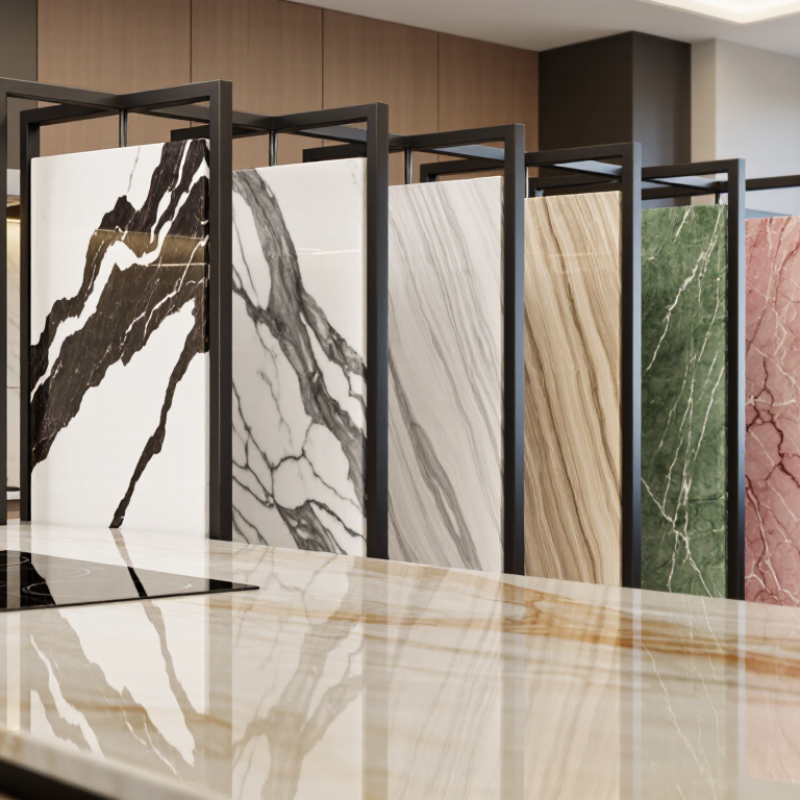
Marble is a calcite-rich natural stone, and its beauty comes with a practical trade-off. On the Mohs scale, it ranks around 3, so sand, ceramic dishes, and unprotected knife work can leave scratches. That is relatively soft. The number describes scratch resistance, not overall strength, and it does not predict every countertop’s performance.
Acids create a separate concern. Lemon juice, vinegar, and some cleaners can react with calcite, dulling the surface in a mark called etching. A sealer may help reduce staining, but it cannot prevent scratches or acid damage. This distinction is easy to miss when comparing countertop samples under showroom lights. A polished finish reflects more light, while a honed finish looks softer and may make small marks less conspicuous; neither changes the stone’s basic hardness. In a working kitchen, use cutting boards and wipe spills promptly. Even careful owners may collect a few marks over time. Whether that feels like character or damage is worth considering before choosing marble.
| Marble type | Typical appearance | Common source region | Mineral and hardness basics | Countertop considerations |
|---|---|---|---|---|
| Carrara | White to light gray background with fine, soft gray veining. | Carrara area, Tuscany, Italy. | Generally calcite-rich; calcite ranks about 3 on the Mohs scale. | A widely used, classic look. Acidic foods can etch the surface, and regular care helps limit staining. |
| Calacatta | Usually a white or warm-white ground with bold gray or gold-toned veining. | Apuan Alps, Tuscany, Italy. | Calcite-rich marble; hardness is commonly described as about 3 on the Mohs scale. | Distinctive veining can create a strong focal point. Slab patterns vary, so view the actual slab before selection. |
| Statuario | Bright white background with prominent, often dramatic gray veining. | Apuan Alps, Tuscany, Italy. | Typically calcite-rich; calcite has a Mohs hardness of about 3. | A high-contrast choice. Like other marble, it is susceptible to scratching, etching, and staining without careful use. |
| Crema Marfil | Cream to beige tones, often with subtle veining or occasional fossil details. | Alicante region, Spain. | A calcite-bearing marble; hardness depends on the stone’s mineral makeup but is commonly near the marble range of about 3. | Warm neutral coloring suits many interiors. Inspect slabs for variation in shade, veining, and natural features. |
| Danby | White to light gray, with gray veining that varies by selection. | Vermont, United States. | A calcite marble; calcite ranks about 3 on the Mohs scale. Exact composition varies by deposit. | Offers a light-colored marble option from a U.S. source. As with other marble, use cutting boards and clean spills promptly. |
| Emperador | Brown to deep brown background, often crossed by lighter veins. | Commonly quarried in Spain; related commercial varieties also come from other countries. | A carbonate stone commonly sold as marble; mineral proportions and hardness can vary between deposits. | Its darker color can make some marks less conspicuous, but it is still vulnerable to etching and surface wear. |
| Nero Marquina | Black background with contrasting white veins. | Basque Country, Spain. | A dark carbonate marble; its precise mineral composition varies. Marble surfaces are generally softer than quartz or granite. | Creates a strong contrast in a room. Inspect the finish and slab for natural fissures and variation in veining. |
| Arabescato | White or pale background with distinctive looping, web-like gray veining. | Apuan Alps, Tuscany, Italy. | Typically calcite-rich; calcite ranks about 3 on the Mohs scale. | The patterned veining makes each slab visually different. Review slab layout and seams with the fabricator. |
Carrara, Calacatta, and Statuario are all Italian marbles, commonly associated with the Apuan Alps near Carrara. Their differences show best in the slab, not the name alone. Carrara usually has a soft white or pale-gray ground with fine, misty gray veining. Calacatta tends to look brighter, with fewer, broader veins that may be gray or warm gold. Statuario often combines a luminous white background with strong, sweeping gray veins. Some slabs blur these distinctions.
Names can mislead. Quarry, cut, and supplier grading affect each slab’s appearance, so inspect the actual piece in natural light. The U.S. Geological Survey’s Mineral Commodity Summaries 2025 tracks dimension stone by material category, not by retail names such as Calacatta; its production data cannot confirm a slab’s label.
The Natural Stone Institute’s care guidance also notes marble’s sensitivity to acidic substances.
A lemon ring can leave a dull mark.
That matters on a busy kitchen counter. The most dramatic veining is not always the easiest to live with. Some buyers regret choosing from a small sample.
Danby marble is quarried in Vermont, where cool winters and distinct geological layers contribute to its familiar pale appearance. Most slabs range from soft white to warm ivory, with gray veining that can look fine and feathery or broad and cloudlike. Some blocks show faint gold or taupe notes. The pattern changes from slab to slab, even within one quarry area. That matters. A small sample may miss a dramatic vein running across the full counter.
Crema Marfil comes from southeastern Spain, especially the Alicante region. Its typical palette runs from light cream to beige, often with delicate veins in honey, gray, or muted rust. Certain slabs look nearly uniform; others have scattered fossils or stronger patches of color. “Beige” is not one fixed shade. Lighting can make a sample seem warmer at home than it looked in a showroom. That sounds tidy, but stone rarely is. Ask to view the actual slab, not only a small chip, and check it under warm and cool light. I would also compare the veining with cabinet and floor samples; otherwise, a quiet cream surface can feel unexpectedly busy beside patterned materials.
What Are the Top Types of Marble Countertops in 2026?
Marble choices range from soft white stone with fine gray veining to darker slabs with bold, branching patterns. Appearance matters, but performance data helps set realistic expectations. ASTM C97 measures water absorption by weighing stone samples before and after drying and saturation. A lower result indicates less water uptake in the tested sample. It does not mean the countertop is stain-proof. Marble can still mark when spills sit on its surface.
ASTM C880 measures flexural strength: how much bending stress a stone specimen withstands under specified test conditions. Ask for the reported value, test orientation, and whether specimens were tested wet or dry. Results can vary within a slab and between quarry lots. A lab figure is useful, but it cannot predict every crack or impact in a busy kitchen. Real installations include cutouts, seams, and support conditions that test specimens do not.
Tips: Request C97 and C880 reports for the actual stone type and, when possible, the same lot. Compare test conditions, not just numbers. Seal the surface as recommended, wipe up acidic spills promptly, and inspect areas around sinks and cooktops. One thing is easy to overlook: even strong test results do not remove marble’s need for careful use.
Common choices include Carrara, Calacatta, Statuario, Crema Marfil, and Emperador. The chart shows broad, approximate ranges reported for marble—not guaranteed results for any named variety or slab.
ASTM C97 measures water absorption; lower absorption generally means less water uptake. ASTM C880 measures flexural strength, or resistance to bending. Results vary by quarry, slab, finish, and test conditions, so request test data for the specific stone you plan to install.
For a 2026 marble countertop, thickness affects the look, support needs, and overall feel of the kitchen. A 2 cm slab has a lighter profile and can suit compact spaces or cabinets with limited visual weight. It may require a suitable substrate or added support, depending on the design and installation. Confirm this with the fabricator before ordering.
A 3 cm slab creates a deeper edge and a more substantial appearance. Its extra weight matters: cabinets and supports must be checked, especially around a long island or sink cutout.
The thicker edge is not automatically stronger in every spot. Marble can still chip at exposed corners, and the stone’s veining may influence where cuts are safest. Small details count.
Compare actual samples beside your cabinet finish, not just photos. A 2 cm sample can appear delicate under bright showroom lights, while a 3 cm edge may feel too heavy in a narrow room. Neither choice is universally better. Ask how the installer will support the slab, finish the edge, and handle seams. One detail is easy to overlook: the finished edge can change the apparent thickness, so inspect that profile before committing.
| Cookie | Duration | Description |
|---|---|---|
| cookielawinfo-checkbox-analytics | 11 months | This cookie is set by GDPR Cookie Consent plugin. The cookie is used to store the user consent for the cookies in the category "Analytics". |
| cookielawinfo-checkbox-functional | 11 months | The cookie is set by GDPR cookie consent to record the user consent for the cookies in the category "Functional". |
| cookielawinfo-checkbox-necessary | 11 months | This cookie is set by GDPR Cookie Consent plugin. The cookies is used to store the user consent for the cookies in the category "Necessary". |
| cookielawinfo-checkbox-others | 11 months | This cookie is set by GDPR Cookie Consent plugin. The cookie is used to store the user consent for the cookies in the category "Other. |
| cookielawinfo-checkbox-performance | 11 months | This cookie is set by GDPR Cookie Consent plugin. The cookie is used to store the user consent for the cookies in the category "Performance". |
| viewed_cookie_policy | 11 months | The cookie is set by the GDPR Cookie Consent plugin and is used to store whether or not user has consented to the use of cookies. It does not store any personal data. |