
What is an Air Conditioner Making Machine? The term sounds simple, yet it covers a wide range of industrial equipment. In practice, an Air Conditioner Making Machine may form, cut, bend, weld, assemble, or test air-conditioning components. These components include metal panels, coils, pipes, brackets, and finished indoor units. A factory may use one specialized machine or connect several machines into one production line.
Understanding this equipment requires more than checking speed or appearance. Experienced manufacturers examine forming accuracy, refrigeration compatibility, electrical safety, energy use, and maintenance access. A reliable machine should produce consistent dimensions, clean joints, and repeatable test results. For example, a poorly aligned pipe can cause leakage risks, even when the cabinet looks flawless. Quality control matters at every stage. So does operator training.
The right choice depends on product type, output volume, material thickness, factory layout, and local compliance requirements. A small workshop may need flexible equipment, while a large plant may prioritize automation and data tracking. Automation is not always better. It can increase costs when technical support is limited. This article explains machine categories, working processes, key specifications, and practical selection factors. Supplier terminology can also vary. That creates confusion. Careful comparison remains necessary.
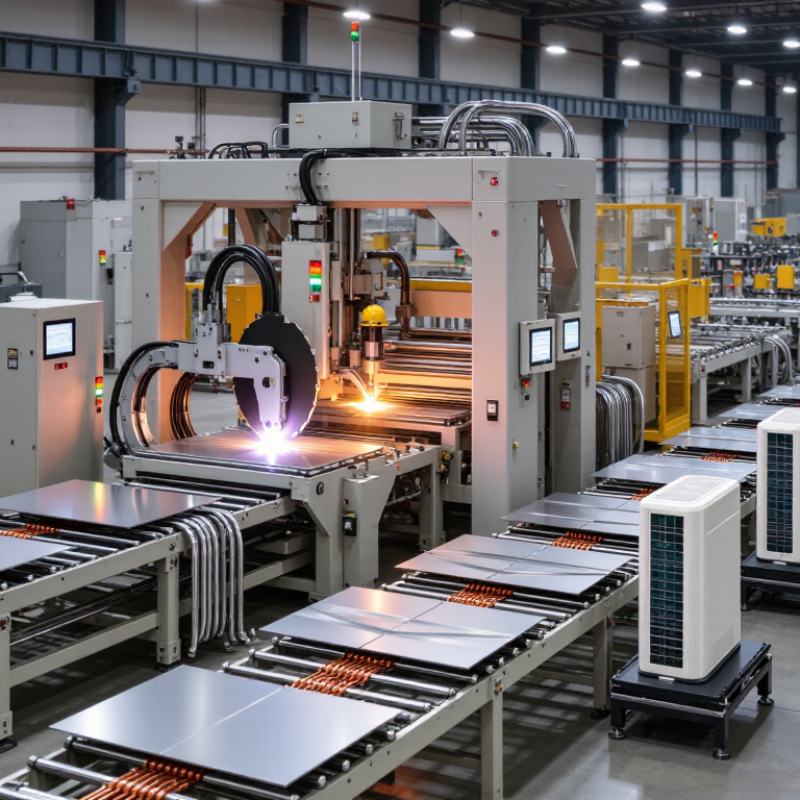
An air conditioner making machine is equipment used to manufacture, assemble, and test air-conditioning units. The phrase is imperfect. It does not describe one universal machine. In practice, it may refer to a complete production line or a specialized station. Typical equipment forms sheet-metal cabinets, bends copper tubes, builds heat-exchanger coils, performs controlled brazing, and installs electrical components. Automated leak testing and refrigerant charging follow. Each stage affects cooling capacity, durability, and workplace safety.
Its main purpose is repeatable production with measurable quality. A calibrated vacuum system removes moisture before charging. A pressure test can reveal a weak joint before the unit reaches a customer. End-of-line testing measures airflow, temperature difference, power consumption, noise, and refrigerant leakage. These details matter because field repairs are costly and often inconvenient. However, automation cannot correct poor design or careless maintenance. Human inspection still has value.
The International Energy Agency reported in The Future of Cooling that cooling accounts for about 10% of global electricity use, while demand could more than triple by 2050 without stronger efficiency improvements. The United Nations Environment Programme also links efficient cooling with lower energy demand and reduced refrigerant impact. Therefore, modern manufacturing equipment must support precise charging, efficient compressors, reliable insulation, and traceable testing records. A faster line is not automatically a better line. That assumption deserves review.
An air conditioner making machine is not one device. It is a coordinated production line that forms, joins, tests, and prepares cooling units for use. Its main sections include sheet-metal forming, tube bending, fin assembly, compressor mounting, brazing, refrigerant charging, and electrical inspection. Conveyors connect these stations, while PLC controls coordinate timing and movement. Servo drives position parts accurately, but small alignment errors can still create vibration or airflow problems.
The refrigeration circuit is the line’s technical center. Copper tubes connect the compressor, condenser, expansion device, and evaporator. During assembly, automated brazing heats each joint until the filler metal seals the connection. A pressure-decay or helium test then checks for leaks. The system may also use vacuum pumps to remove moisture before controlled refrigerant charging. The International Energy Agency reports that space-cooling demand could more than triple by 2050, increasing pressure for efficient and reliable manufacturing (IEA, The Future of Cooling, 2018).
Final testing measures cooling capacity, power input, noise, airflow, and electrical safety. Sensors record temperature differences across the evaporator and condenser. The Global Cooling Watch 2023 report states that cooling equipment demand is expected to grow sharply as incomes and temperatures rise. That growth makes process consistency important. Still, automation is not perfect. A sensor can drift, a brazed joint can look clean but leak, and software cannot replace skilled inspection. The best machines combine data with experienced technicians who question abnormal results.
What Is an Air Conditioner Making Machine?
Main Manufacturing Processes for Air Conditioning Units
An air conditioner making machine is not one device. It is a connected production system. Sheet-metal presses form cabinets and mounting plates. CNC bending tools create consistent edges. Technicians join panels with spot welding or controlled fastening. Surface cleaning and powder coating protect the metal from moisture. In practice, small burrs can damage wiring insulation. Small errors matter.
The thermal core requires careful assembly. Copper tubes pass through aluminum fins, then expand for close contact. Automated brazing joins the circuit, while visual checks inspect each joint. Fans, motors, filters, and control boards follow a defined installation sequence. Workers use torque-controlled tools on critical connections. A loose terminal may create heat later. It is not always obvious during assembly.
Testing gives the process its reliability. Each unit should undergo pressure or leak testing before evacuation and refrigerant charging. Vacuum readings help reveal moisture or trapped air. Electrical insulation, grounding, airflow, noise, and temperature performance also need verification. Digital records link results to operators and production batches. Still, no machine replaces judgment. Sensors drift, fixtures wear, and rushed inspections happen. Reviewing failed units honestly improves future production. Details decide quality.
Air conditioner production typically moves from sheet-metal forming and heat-exchanger fabrication to component assembly, refrigerant circuit joining, electrical testing, leak testing, evacuation, refrigerant charging, and final performance inspection. The values shown represent relative production emphasis on a 1–5 process-intensity scale; exact requirements vary by unit design and factory.
What Is an Air Conditioner Making Machine?
Types of Air Conditioner Making Machines
An air conditioner making machine is industrial equipment used to shape, join, assemble, or test cooling units. In a working factory, these machines handle metal sheets, copper tubes, insulation, wiring, and plastic parts. Each machine supports one stage of production. The equipment must deliver stable results because small leaks can reduce cooling performance.
Sheet metal machines form cabinet panels, brackets, and outdoor housings. They may use cutting, bending, punching, and stamping processes. A precise bend helps panels fit without forcing screws into misaligned holes. Coil processing machines create evaporator and condenser coils from copper tubing and aluminum fins. Tube benders control the radius carefully. A sharp bend can restrict refrigerant flow.
Assembly machines install fans, motors, filters, and electrical components. Some use guided tools to control tightening force. Others assist workers with lifting heavy units. Refrigerant charging and leak-testing machines check sealed circuits under controlled conditions. Electronic testing equipment measures voltage, current, airflow, and temperature. It can reveal a weak connection before shipment.
Not every factory needs full automation. A smaller workshop may prefer flexible machines and skilled operators. That choice can reduce waste, although production speed may fall. I have found that calibration is often overlooked. It should not be. Regular inspection, documented maintenance, and trained supervision improve consistency and workplace safety.
| Machine Type | Primary Manufacturing Stage | Main Materials or Components | Typical Function | Common Output | Important Quality Checks | Automation Level |
|---|---|---|---|---|---|---|
| Sheet Metal Cutting Machine | Cabinet and panel fabrication | Galvanized steel, stainless steel, aluminum sheet | Cuts flat sheets into accurately sized panels and blanks | Housing panels, brackets, base plates, and covers | Cut dimensions, edge condition, burr formation, and squareness | Semi-automatic to fully automatic |
| CNC Punching or Laser Cutting Machine | Precision panel processing | Steel and aluminum sheet metal | Creates holes, louvers, ventilation slots, and detailed contours | Fan openings, mounting holes, grille panels, and service access panels | Hole position, dimensional accuracy, heat distortion, and surface finish | Computer-controlled |
| Press Brake | Panel forming and enclosure assembly | Coated steel, galvanized steel, and aluminum sheet | Bends sheet metal to produce structural shapes and flanges | Indoor-unit shells, outdoor-unit cabinets, and mounting frames | Bend angle, flange length, springback, and surface damage | Manual, CNC-assisted, or robotic |
| Fin Press Machine | Heat-exchanger manufacturing | Thin aluminum or copper fin stock | Stamps collars, louvers, and fin patterns for heat transfer | Evaporator and condenser fins | Fin pitch, collar height, burrs, flatness, and material feeding accuracy | High-speed automatic |
| Tube Bending and Expanding Machine | Heat-exchanger coil assembly | Copper or aluminum tubing | Forms tubes and expands them to make close contact with fins | Coil circuits and assembled tube-fin heat exchangers | Tube position, bend radius, expansion consistency, and blockage | Semi-automatic to fully automatic |
| Tube Cutting and Deburring Machine | Refrigeration circuit preparation | Copper, aluminum, or steel tubing | Cuts tubes to length and removes sharp internal or external edges | Connecting tubes, suction lines, liquid lines, and coil sections | Length, perpendicularity, cleanliness, and absence of metal chips | Automatic or operator-assisted |
| Brazing Station | Refrigeration circuit joining | Copper tubing, filler metal, valves, and coil connections | Permanently joins refrigerant tubes and circuit components | Sealed refrigerant piping assemblies | Joint strength, penetration, oxidation control, cleanliness, and leakage | Manual, fixture-assisted, or robotic |
| Vacuum and Refrigerant Charging Machine | Final refrigeration-system processing | Completed refrigerant circuit and approved refrigerant | Removes air and moisture, checks vacuum stability, and charges a measured amount of refrigerant | Charged and sealed air-conditioning units | Vacuum level, holding time, charging mass, connection integrity, and refrigerant traceability | Automatic or programmable |
| Helium or Pressure Leak Tester | Leak inspection and safety validation | Refrigerant circuit, heat exchanger, valves, and brazed joints | Detects leaks using pressure decay, tracer gas, or another approved method | Verified sealed circuits and rejected leaking assemblies | Leak-rate limit, test pressure, stabilization time, and calibration status | Semi-automatic to fully automatic |
| Electrical Safety and Functional Test System | End-of-line testing | Wiring harnesses, motors, compressors, control boards, and completed units | Checks electrical safety, controls, sensors, airflow, and operating response | Tested residential, commercial, or packaged air conditioners | Insulation resistance, grounding continuity, voltage, current, noise, and operating performance | Programmable and automated |
What Is an Air Conditioner Making Machine?
An air conditioner making machine is industrial equipment used to build, shape, test, or assemble cooling units. It may form copper tubes, join coils, charge refrigerant, or verify electrical performance. Quality begins with repeatable settings, clean contact surfaces, and documented inspection points. Operators should measure tube dimensions, joint strength, airflow, and leak rates against approved specifications. Small defects matter. A poorly sealed connection can reduce efficiency, damage the compressor, and create service risks.
Safety controls must protect workers from moving parts, heat, electricity, pressure, and chemical exposure. Guards should remain fitted during production. Emergency stops need clear labels and regular functional tests. Technicians should isolate power before opening panels or clearing jams. Ventilation is important during brazing and refrigerant handling. Protective eyewear, gloves, and suitable work clothing reduce preventable injuries. Training should include practical demonstrations, not only signed forms. A signature proves attendance, not competence.
Maintenance keeps production stable and protects product quality. Inspect belts, clamps, sensors, hoses, and electrical connections on a planned schedule. Clean dust from cooling vents and remove metal fragments from work areas. Calibrate pressure gauges, temperature probes, and leak detectors using traceable references. Record faults, adjustments, and replacement dates. In real workshops, perfect consistency is difficult. That limitation deserves attention, not excuses. A rushed repair may restore output today while creating a larger failure tomorrow. Good maintenance leaves evidence that another technician can understand.
| Cookie | Duration | Description |
|---|---|---|
| cookielawinfo-checkbox-analytics | 11 months | This cookie is set by GDPR Cookie Consent plugin. The cookie is used to store the user consent for the cookies in the category "Analytics". |
| cookielawinfo-checkbox-functional | 11 months | The cookie is set by GDPR cookie consent to record the user consent for the cookies in the category "Functional". |
| cookielawinfo-checkbox-necessary | 11 months | This cookie is set by GDPR Cookie Consent plugin. The cookies is used to store the user consent for the cookies in the category "Necessary". |
| cookielawinfo-checkbox-others | 11 months | This cookie is set by GDPR Cookie Consent plugin. The cookie is used to store the user consent for the cookies in the category "Other. |
| cookielawinfo-checkbox-performance | 11 months | This cookie is set by GDPR Cookie Consent plugin. The cookie is used to store the user consent for the cookies in the category "Performance". |
| viewed_cookie_policy | 11 months | The cookie is set by the GDPR Cookie Consent plugin and is used to store whether or not user has consented to the use of cookies. It does not store any personal data. |