
An explosion-proof LED floodlight is designed for areas where flammable gas, vapor, or combustible dust may be present. Its robust enclosure contains a fault or internal ignition, helping prevent flames or hot gases from reaching the surrounding atmosphere. The LED source provides focused illumination, while the housing and seals are engineered for demanding industrial conditions.
The phrase can be misleading. It does not mean the light cannot fail or explode under any circumstance. Protection depends on the product’s tested design, correct installation, and suitability for the specific hazardous location. A unit intended for one gas group, temperature range, or dust environment may not be appropriate for another. Check the product markings and manufacturer documentation rather than relying on appearance alone.
Think of a refinery walkway at night: workers need clear light across pipes, valves, and access routes, but the fitting must also match the site’s classified area. That choice should consider the hazard type, required light output, ambient temperature, mounting position, and maintenance needs. Small details matter.
This guide explains how an explosion-proof led floodlight works, which features to compare, and what questions to ask before purchase. It is not a substitute for a site assessment. Have qualified personnel confirm the area classification and installation requirements. Even a well-built fixture is only as reliable as its application.
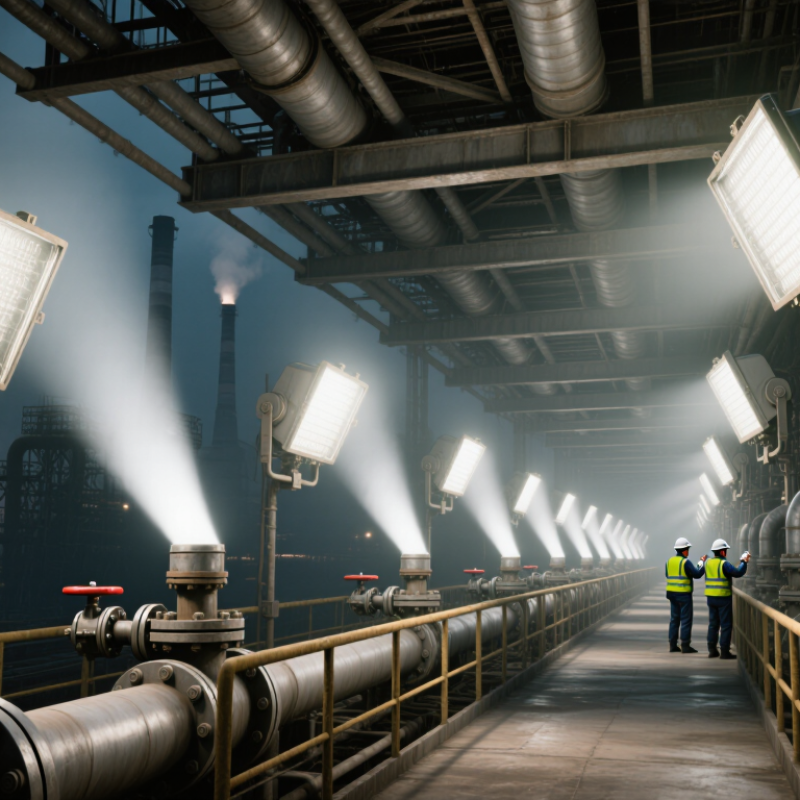
An explosion-proof LED floodlight is a lighting fixture built for locations where flammable gases, vapors, or combustible dust may be present. Its enclosure is designed to contain an internal ignition and prevent flames or hot gases from igniting the surrounding atmosphere. The term can mislead: it does not mean the fixture cannot fail or that every hazardous location is suitable. Its protection depends on its certification, marked hazard classification, temperature rating, and correct installation. That distinction matters.
Inside the fixture, LED modules produce light with less energy than older lamp types, while a sealed, robust housing helps protect electrical parts from harsh conditions. The U.S. Department of Energy reports that LEDs use at least 75% less energy and can last up to 25 times longer than incandescent lighting. Those figures describe LEDs broadly, not every explosion-proof floodlight; heat, vibration, and maintenance can affect actual service life. A label alone is not enough. Check the marking against the site’s specific gas or dust risks, and follow the applicable IEC 60079 requirements and manufacturer instructions. Even experienced teams can overlook a cable entry or damaged seal. That deserves a second look.
| Dimension | Explanation | Practical Details |
|---|---|---|
| Definition | An explosion-proof LED floodlight is a luminaire designed and certified for use in specified hazardous areas where flammable gases, vapors, or combustible dust may be present. | Its construction is intended to contain an internal ignition or prevent the light from becoming an ignition source, according to the protection method and certification applicable to the product. |
| How the protection works | In flameproof or explosion-proof designs, a strong enclosure and carefully engineered joints can contain an internal explosion and cool escaping gases so they do not ignite the surrounding atmosphere. | “Explosion-proof” does not mean that the fixture cannot fail or that it is suitable for every hazardous location. Installation must follow its certification and instructions. |
| Typical applications | Examples include oil and gas facilities, chemical processing areas, fuel handling locations, paint operations, and some grain or dust-handling facilities. | The site’s hazard assessment determines whether the risk involves gas, vapor, dust, or another condition, and which equipment is appropriate. |
| Hazardous-area classification | Equipment is selected for the specific area classification, gas or dust group, and required protection level. | Systems differ by region. For example, North American Class/Division or Zone designations and IEC-based Zone classifications are not interchangeable without checking applicable rules and product markings. |
| Temperature rating | The temperature class or maximum surface-temperature marking indicates the highest permitted temperature under specified conditions. | It must be suitable for the ignition characteristics of the substances present and for the site’s ambient temperature range. Do not infer suitability from wattage alone. |
| Ingress protection | An IP rating describes resistance to dust and water entry; it is separate from hazardous-location certification. | Higher IP ratings may be useful in wet or dusty environments, but an IP rating by itself does not make a light safe for an explosive atmosphere. |
| LED performance | LED technology produces light efficiently and generally requires less frequent lamp replacement than many traditional light sources. | Output, power consumption, beam distribution, color temperature, and service life vary by design. Check the product’s verified photometric and electrical data for the application. |
| Housing and optical parts | Common design considerations include a robust enclosure, heat management, sealed cable entries, and impact-resistant optical components. | Materials and construction vary. Any cable glands, conduit entries, mounting hardware, and accessories must be compatible with the fixture’s certification and installation requirements. |
| Certification and markings | Certification indicates that a specific model has been assessed for stated conditions of use under a defined scheme. | Verify the certification label, protection concept, area classification, temperature rating, ambient limits, and permitted installation method. Requirements vary by country and jurisdiction. |
| Selection checklist | Start with the hazardous-area assessment, then match the fixture to the substances, area classification, environmental conditions, and lighting requirements. | Also review supply voltage, mounting position, beam angle, maintenance access, ambient temperature, and the instructions for inspection and installation. |
| Important safety note | Choosing or installing hazardous-area lighting is a safety-critical task. | Use equipment approved for the exact location and have selection, installation, and inspection performed in accordance with local regulations and qualified professional guidance. |
An explosion-proof LED floodlight is designed for locations where flammable gas, vapor, or dust may be present. Its housing does not make ignition impossible. Instead, it limits how an internal spark or hot surface can affect the surrounding atmosphere. The thick enclosure contains pressure from an internal ignition, while carefully machined joints cool escaping gases before they reach nearby fuel. Small gaps matter. That is why flamepaths, fasteners, and enclosure surfaces are engineered as a system, not as decorative details. LEDs often produce less heat than older light sources, but they still need controlled operating temperatures.
Thermal design keeps the hottest accessible surface within the limit specified for the intended location. Cable entries, glands, and seals must match the fixture’s rating; a poor connection can undermine an otherwise sound enclosure. Installers also need to follow the product documentation, including mounting position and supply limits. This can feel fussy. Yet dust on a lens, corrosion at a joint, or a damaged thread can affect performance over time. Routine inspection helps catch these changes early. Ratings are specific, not universal: confirm the atmosphere, temperature class, and installation conditions with a qualified specialist.
What Is an Explosion Proof LED Floodlight?
The Main Components and Protection Features
An explosion-proof LED floodlight combines an LED module, driver, heat-dissipating housing, sealed lens, and certified cable entries. The housing is commonly metal, while a tough glass lens protects the light source. Gaskets and properly matched cable glands help keep dust or moisture from entering. Small details matter.
Protection depends on the complete assembly, not just a thick casing. Certified flameproof designs are built to contain an internal ignition and prevent flames from reaching the surrounding atmosphere. Temperature limits also help reduce the risk of hot surfaces igniting nearby hazards. The IEC 60079 series sets out requirements for equipment used in explosive atmospheres. Separately, U.S. Department of Energy Energy Saver guidance reports that LEDs use at least 75% less energy and can last up to 25 times longer than incandescent lighting; these are general LED figures, not a guarantee for every floodlight. A label alone is not enough.
Tips: Match the light’s certification, temperature class, and gas or dust rating to the site assessment. Check cable entries, seals, and mounting points during installation. A practical weakness remains: even excellent hardware can be undermined by poor fit or maintenance.
An explosion-protected LED floodlight combines an LED module and driver with a suitably certified enclosure, sealed cable entries, and protective joints or other design features required by its protection method. The chart compares the ingress-protection digits defined by IEC 60529: the first digit indicates dust protection, and the second indicates water protection. These IP ratings describe resistance to dust and water; they do not certify protection against ignition in an explosive atmosphere. Always check the product’s specific hazardous-area certification and installation requirements.
What Is an Explosion Proof LED Floodlight?
Hazardous Areas Where These Floodlights Are Used
Explosion-proof LED floodlights are designed and certified for specific hazardous locations. Their enclosures help prevent an internal electrical fault from igniting nearby flammable gases, vapors, or combustible dust. They are used in places such as fuel-loading areas, chemical plants, paint-finishing rooms, and grain-processing facilities. Conditions differ from site to site. A fixture suited to gas hazards may not be suitable for dust.
Tips: Check the area classification, temperature rating, and dust or moisture protection before choosing a light. Have a qualified professional verify that the fixture matches the actual hazard. A familiar-looking fixture can still be the wrong choice.
In a fuel-loading bay, for example, lighting may face vapor exposure, vibration, and frequent washdowns. In a grain facility, fine dust can collect on surfaces and affect both safety and heat dissipation. The correct floodlight depends on the substances present, their likely concentration, and the installation location. Even a certified product can be unsafe if its cable entries, seals, or mounting are unsuitable. Maintenance matters, too: damaged seals or loose fittings should be inspected promptly. The details are easy to overlook.
Selecting a floodlight starts with the area, not the wattage. Check the hazardous-area classification, including the gas or dust group and required temperature rating. The fixture’s certification must match the actual location; “explosion proof” alone is not enough. Then measure the mounting height, target distance, and coverage width. A narrow beam can reach a loading bay across a yard, while a wider beam may suit a low ceiling. Review photometric data to estimate illuminance and spot dark gaps before installation.
Tips: Match the beam angle to the mounting height, and check glare from nearby walkways. Consider dust, moisture, vibration, and ambient temperature. The U.S. Department of Energy’s LED Lighting factsheet reports that LEDs use at least 75% less energy and last up to 25 times longer than incandescent lighting. This is a useful efficiency benchmark, but it does not predict savings against every existing fixture. Small details matter. I treat a lux target as a starting point, not a promise; surface color and maintenance can change results. Verify the final layout with site measurements and qualified lighting advice.
| Cookie | Duration | Description |
|---|---|---|
| cookielawinfo-checkbox-analytics | 11 months | This cookie is set by GDPR Cookie Consent plugin. The cookie is used to store the user consent for the cookies in the category "Analytics". |
| cookielawinfo-checkbox-functional | 11 months | The cookie is set by GDPR cookie consent to record the user consent for the cookies in the category "Functional". |
| cookielawinfo-checkbox-necessary | 11 months | This cookie is set by GDPR Cookie Consent plugin. The cookies is used to store the user consent for the cookies in the category "Necessary". |
| cookielawinfo-checkbox-others | 11 months | This cookie is set by GDPR Cookie Consent plugin. The cookie is used to store the user consent for the cookies in the category "Other. |
| cookielawinfo-checkbox-performance | 11 months | This cookie is set by GDPR Cookie Consent plugin. The cookie is used to store the user consent for the cookies in the category "Performance". |
| viewed_cookie_policy | 11 months | The cookie is set by the GDPR Cookie Consent plugin and is used to store whether or not user has consented to the use of cookies. It does not store any personal data. |