Choosing the best hand grinder in 2026 means matching its strengths to your daily brewing, not chasing one universal winner. A travel brewer may value a compact body and a secure catch cup. At home, steady adjustment and comfortable grinding can matter more. Small details show up quickly: a loose handle, a slippery grip, or grounds left around the burrs.
Coffee educator James Hoffmann has emphasized, “The grinder is the most important piece of coffee equipment.” That idea helps frame this guide, but it does not settle the choice. Burr alignment, adjustment range, build quality, and the effort needed for a morning dose all deserve attention. So does the coffee itself. A setting that suits a light-roast pour-over may not work well for espresso.
There is no perfect pick. Not quite. Some grinders feel sturdy yet take longer to turn; others are fast but less pleasant to hold. This outline compares leading hand grinder options through practical features, brewing performance, portability, and value. It also considers what owners may notice after months of use, rather than relying only on polished specifications. The goal is a clear, careful shortlist—not a promise that one model will suit every hand, budget, or cup.
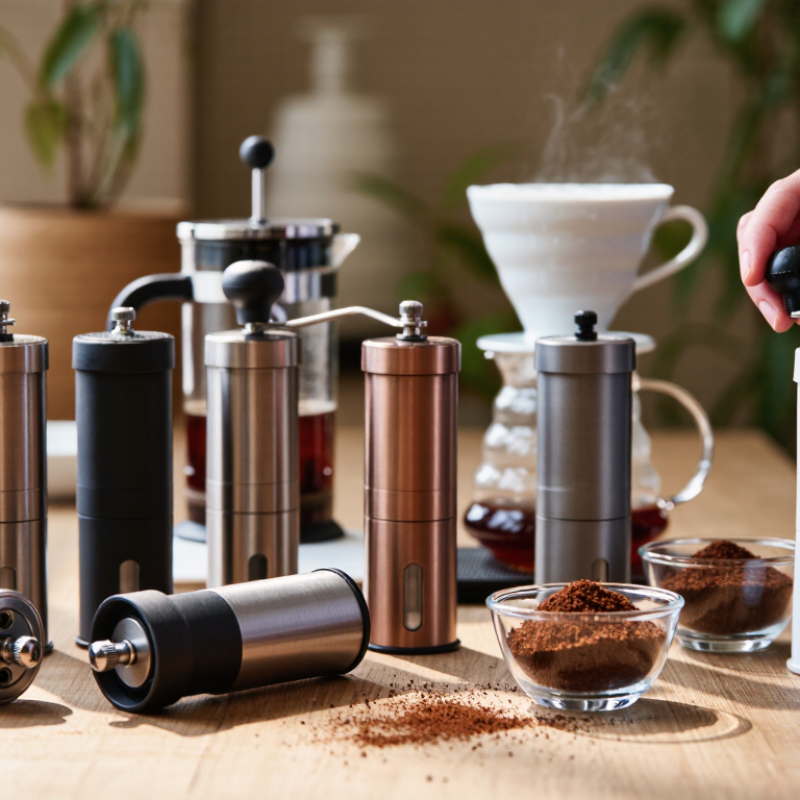
The best hand grinder in 2026 depends on what you brew, not on a single universal ranking. Espresso needs small, controlled adjustments because a slight change can alter shot time and flavor. Pour-over usually benefits from a consistent grind and adjustments wide enough to respond to different beans. For French press, coarse settings matter, but so does limiting fine dust that can muddy the cup.
Consistency is easy to overlook until the coffee tastes uneven. A useful check is to grind the same dose twice and compare the grounds, then brew both with the same recipe. Look for a stable adjustment mechanism, clear setting changes, and burrs that stay aligned during use. In the cup, note whether bitterness, sourness, or weak body shifts predictably when you adjust the grind. Small details matter.
Range should match your routine. Someone switching between espresso and pour-over needs more adjustment steps than someone brewing one method daily. A grinder can offer many settings and still feel awkward. I’ve sometimes valued quick, repeatable adjustments more than an impressive number of clicks; that preference may not suit everyone. Check how easily the handle turns, whether grounds cling inside, and how comfortable the grip feels after a full dose. A little mess is normal. The right choice is the one whose consistency and usable range fit your brewing habits, not merely the widest advertised range.
A capable hand grinder should move cleanly from espresso-fine to coarse French-press settings, but its adjustment count alone proves little. Burr geometry and alignment affect how evenly beans break apart. Uneven particles can leave a cup both sharp and dull. Look for repeatable adjustments, secure burr support, and clear feedback between clicks. Tiny steps help espresso dialing; broader, consistent steps matter for pour-over and immersion. More settings are not always better.
The Specialty Coffee Association’s Brewing Control Chart places brewed coffee’s target extraction yield at 18–22%, with a target strength of 1.15–1.35% total dissolved solids. These are brewing targets, not grinder test scores, but they show why repeatable particle size matters: it helps control extraction. For espresso, check whether the grinder can make small, consistent adjustments without drifting. For coarse brewing, inspect whether it avoids excessive fines that can muddy the cup. A practical test is simple: grind the same dose twice, compare the grounds, then brew both. I would not judge by appearance alone. It is easy to overvalue a long settings list and miss poor adjustment feel. The honest trade-off: one grinder may cover every method, but switching ranges can be tedious.
The best choice depends on your brew method, adjustment needs, and willingness to trade portability for grinding speed. This comparison uses representative hand-grinder categories rather than specific branded products.
| Grinder Type | Typical Burr Design | Adjustment Style | Espresso to Coarse Range | Typical Capacity | Portability | Best For | Overall Fit |
|---|---|---|---|---|---|---|---|
| Compact travel grinder | Conical steel burrs, often around 38–40 mm | Stepped adjustment; commonly about 30–50 usable positions | Usually strongest for pour-over, AeroPress-style brewing, and French press; espresso adjustment may be limited | About 18–25 g | High; typically lighter and easy to pack | Travel, camping, and one-cup brewing | Best for portability, not for frequent espresso dialing |
| All-round steel-burr grinder | Conical steel burrs, commonly around 40–48 mm | Stepped or fine-click adjustment; often roughly 40–80 positions | Can cover espresso through coarse brewing, though the espresso range and precision vary by adjustment design | About 20–30 g | Medium-high; suitable for daily use and occasional travel | Households using several brew methods | Best general-purpose balance for most users |
| Espresso-focused grinder | Conical steel burrs, often around 40–48 mm, with an emphasis on fine adjustment | Fine stepped or stepless adjustment; small changes between settings | Designed for espresso dialing; many models also reach pour-over and medium-coarse settings | About 20–30 g | Medium; adjustment precision may add complexity to travel use | Manual espresso and frequent recipe changes | Best when espresso control matters more than simplicity |
| Large-burr performance grinder | Larger conical steel burrs, typically around 48–50 mm | Fine stepped adjustment; the number of clicks is model-dependent | Often spans espresso to coarse settings, with grinding speed and consistency prioritized | About 25–40 g | Medium-low; usually bulkier and heavier than compact options | Daily multi-cup brewing and users who value faster grinding | Best for performance at home, with portability as a compromise |
| Ceramic-burr budget grinder | Conical ceramic burrs, generally smaller than premium steel-burr sets | Stepped adjustment; coarser settings are typically easier to manage | Most suitable for pour-over and French press; espresso consistency and fine adjustment can be challenging | About 15–25 g | High; often simple and lightweight | Occasional brewing and entry-level use | Best for low-cost coarse brewing, not precision espresso |
How to choose: For one grinder that handles several brew methods, start with an all-round steel-burr design. Choose an espresso-focused adjustment system if you regularly dial in espresso, or a compact model if packability matters most. Capacity, burr dimensions, click counts, and grind range vary by model; adjustment counts are not directly comparable across different designs.
What Is the Best Hand Grinder in 2026?
A useful starting point is the SCA cupping benchmark: 70–75% of grounds pass through an 850 μm sieve. It gives you a concrete way to compare grind consistency, rather than relying only on a grinder’s adjustment clicks or appearance. Weigh the same coffee dose, grind at a repeatable setting, then sieve and record the passing fraction. Keep the beans and method consistent. Small changes matter.
Why care? A more even particle distribution can help coffee extract more predictably. Too many fine particles may add bitterness or muddy the cup; excess large pieces can leave it thin or sour. But a sieve result is not a flavor score. Roast, freshness, water, and brewing technique all affect what you taste. The number helps narrow a choice, not settle it.
For choosing a hand grinder, look for repeatable results, stable burr alignment, and adjustments fine enough for your brewing method. I would treat the 70–75% range as a comparison point, not a pass-or-fail rule. Sieve tests can be fiddly, and samples may vary between attempts. That is worth admitting. Pair the measurement with a simple cupping: notice sweetness, clarity, and any harsh or hollow finish before deciding which grinder suits you.
Use the 850 μm sieve benchmark as a check on grind consistency: 70–75% of grounds should pass through the sieve.
The chart shows the benchmark range, not test results for specific grinders. Measure each grinder’s grounds under the same conditions and compare the pass rate with this range.
A hand grinder is easier to assess when the brew recipe stays fixed. Use the SCA Golden Cup ratio of 55 grams of coffee per liter of water, with a ±10% range. That means 49.5 to 60.5 grams per liter. For a 500-milliliter brew, the target is 27.5 grams of coffee. Keep the dose, water, beans, and brew method consistent when comparing grind settings. Taste still matters.
Grind the beans just before brewing, then note how evenly the grounds look. A mix of fine dust and large flakes can lead to uneven extraction: the cup may taste both bitter and thin. Brew each sample with the same kettle pour and contact time. Record simple observations, such as dryness, sweetness, and clarity, rather than relying on appearance alone. Repeat the test; one cup can mislead.
The ratio is a useful control, not a verdict on grinder quality. Water temperature, bean age, and pouring technique also affect the result. A grinder that produces a balanced cup near the target ratio may still need a different setting for another coffee. That uncertainty is worth recording, not hiding. A small tasting log can reveal whether adjustments improve the cup or merely change its character.
For 2026, the best hand grinder is not automatically the fastest or lightest. I would rank finalists by timed performance, travel practicality, long-term durability, and cost per year. Use the same coffee dose and grind setting for each test. Time several attempts, because one unusually quick turn can skew the result. Seconds matter, but so does effort. A grinder that feels awkward after a week deserves a lower score.
Portability means more than weight. Check whether the handle folds securely, the adjustment stays put, and the grinder fits a small travel pouch. For durability, inspect the axle, burr alignment, and body for wobble after repeated use. These are practical checks, not laboratory proof. Small parts can wear, and a smooth first impression may not last.
Cost per year is the purchase price divided by expected years of regular use, with replacement parts included when known. A modest grinder used daily for five years may beat a cheaper model that needs replacing sooner. My ranking would favor balanced performance over a single headline feature. Still, durability is hard to judge in a short test. That part is imperfect, and worth revisiting after months of use.
| Cookie | Duration | Description |
|---|---|---|
| cookielawinfo-checkbox-analytics | 11 months | This cookie is set by GDPR Cookie Consent plugin. The cookie is used to store the user consent for the cookies in the category "Analytics". |
| cookielawinfo-checkbox-functional | 11 months | The cookie is set by GDPR cookie consent to record the user consent for the cookies in the category "Functional". |
| cookielawinfo-checkbox-necessary | 11 months | This cookie is set by GDPR Cookie Consent plugin. The cookies is used to store the user consent for the cookies in the category "Necessary". |
| cookielawinfo-checkbox-others | 11 months | This cookie is set by GDPR Cookie Consent plugin. The cookie is used to store the user consent for the cookies in the category "Other. |
| cookielawinfo-checkbox-performance | 11 months | This cookie is set by GDPR Cookie Consent plugin. The cookie is used to store the user consent for the cookies in the category "Performance". |
| viewed_cookie_policy | 11 months | The cookie is set by the GDPR Cookie Consent plugin and is used to store whether or not user has consented to the use of cookies. It does not store any personal data. |